
The Landmaxxing Phenomenon: Wealthy Homeowners Expanding Their Real Estate Horizons
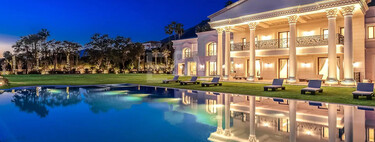
Increasingly, the habits of the ultra-rich are reflecting a newfound obsession with “landmaxxing.” This phenomenon represents a shift away from merely acquiring lavish mansions; instead, billionaires are pursuing the outright purchase of neighboring properties to create larger, private estates. This trend is reshaping the luxury housing market in notable ways.
What is Landmaxxing?
Coined by the real estate consultancy Coldwell Banker in its semiannual report, the term “landmaxxing” parallels the online trend of “lookmaxxing,” where individuals optimize their appearance. The difference lies in its application to real estate; here, the focus is on maximizing one’s property and the land surrounding it. According to the Wall Street Journal, the quest for privacy has driven affluent individuals to engage in a competitive race to purchase contiguous plots.
The Rise in Property Searches
Statistics from Coldwell Banker reveal that searches for building land in the U.S. skyrocketed by 97% year-on-year. In contrast, interests in exclusive properties like private islands have doubled. This indicates a significant preference shift towards larger residential complexes over single-family homes. As Coldwell Banker Miami agent Danny Hertzberg stated, large land holdings are now perceived as both a sanctuary and a safeguard against inflation.
The Price of Privacy
Affluent buyers face unique challenges as they pursue neighboring properties. Often, the primary obstacle arises when potential sellers are reluctant to part with their homes. This reluctance is driving up prices, leading to a “neighbor’s premium,” which can hike costs by as much as 20% above market value. For billionaires, the premium represents the steep price of securing their privacy.
The Masters of the Neighborhood
As noted by real estate agent Ángel Nicolás in the Robb Report, a home encompasses more than just walls; it includes the overall neighborhood experience. This awareness prompts some wealthy individuals to buy neighboring plots without immediate plans for development, as they aim to control who resides nearby. Additionally, landmaxxing is sometimes motivated by environmental concerns, such as fire prevention, giving owners greater space and acting as firebreaks.
High-Profile Examples
A prime illustration of landmaxxing is Jeff Bezos’s approach in Miami’s Indian Creek, commonly referred to as “Billionaire Bunker.” Bezos initially purchased a house for $68 million, subsequently investing $79 million in an adjacent property. His strategy culminated in acquiring three mansions for a cumulative cost exceeding $230 million, with plans to demolish existing structures to develop a single expansive estate.
Equally noteworthy is Mark Zuckerberg’s land acquisition strategy in Palo Alto. Since 2011, he has snapped up over 11 properties for approximately $110 million, expanding his estate into what neighbors mockingly call the “batcave of the billionaires.” His extensive renovations include underground facilities, and he has even gone to great lengths to appease neighbors during construction, sending them gifts to mitigate complaints.
Notable Billionaire Collaborations
Ken Griffin, founder of Citadel, epitomizes the ambitious landmaxxing trend with his extensive real estate purchases in Palm Beach, where he plans to create the most expensive home ever built. Meanwhile, Larry Ellison and David MacNeil took a cooperative approach, buying out a neighbor for $67 million to prevent unwanted development while expanding their respective estates.
Conclusion
As the landmaxxing phenomenon continues to gain traction among millionaires, it is evident that the luxury real estate market is evolving. The desire to create private oases resonating with security, exclusivity, and control over one’s environment is shaping a distinct landscape for affluent homeowners, further emphasizing the luxurious lifestyle that defines their status.