
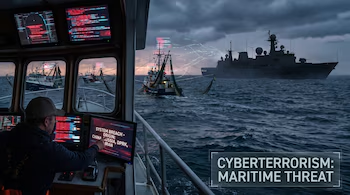
Cyber Sicarios at Sea: The Electronic War Threatening the Argentine Fishing Fleet
Understanding the Current Threat
Since February 28, 2026, captains navigating the Strait of Hormuz have encountered bizarre occurrences on their navigation screens—super tankers appearing to float on land and cargo ships crossing over airports. These anomalies are not mere technical glitches; they are orchestrated satellite interference operations from the Islamic Revolutionary Guard Corps of Iran. This conflict zone, crucial for 20% of the world’s oil and gas supply, marks the first documented instance of large-scale maritime hybrid warfare, affecting not only the flow of trade but the integrity of maritime navigation itself.
Parallel Vulnerabilities in Argentina
At a recent maritime interests conference in Mar del Plata, Captain Jorge A. Frías, general secretary of the Argentine Association of Captains, Pilots, and Fishing Masters (Asociación Argentina de Capitanes, Pilotos y Patrones de Pesca), warned that Argentina’s fishing fleet faces similar vulnerabilities. The nation currently lacks adequate regulatory frameworks to address these digital threats.
The Role of Information and Technology
Modern maritime operations rely increasingly on sophisticated technologies such as the Automatic Identification System (AIS) and blockchain for traceability. These systems promise better data management and operational efficiency. However, while blockchain secures data integrity, it doesn’t confirm the accuracy of that data at the point of entry; manipulated GPS signals can easily lead to fraudulent certification of fish origins.
Navigating the Cyber Landscape
As Frías pointed out, every sensor on a vessel offers potential entry points for cyber attackers, dubbed “cyber sicarios.” The push for digitalization in port operations and fishing vessels has made these entities highly attractive targets. For the Argentine fisheries, GNSS spoofing has emerged not only as a navigation threat but also as a method for laundering illegal fishing activities.
A Defense Strategy
Panel discussions highlighted that, unlike other regions, Argentina lacks cohesive strategies integrating cyber security, fishing activities, and maritime sovereignty. Cybsecurity concerns in maritime operations are rising, with a 300% increase in cyberattacks from 2019 to 2024. With an evident technological gap, the differentiation between the Gulf of Persia and the South Atlantic doesn’t stem from technology but from awareness and preparedness.
Countering the Threat
The key to addressing these vulnerabilities lies in network segmentation—separating operational and administrative networks to mitigate the risks of intrusions. Furthermore, education for personnel is crucial: statistics indicate that 82-95% of successful cyber incidents initiate from human error, revealing a need for a safety culture entwined with ongoing training.
Future Steps for Argentina
The International Maritime Organization has mandated cyber risk management within safety regulations for ships, effective since January 2021. Yet, Argentine law lacks specific provisions addressing cybersecurity in its fishing industry. Without an integrated approach consolidating cybersecurity and fishing regulations, Argentina risks compromising its maritime sovereignty.
Conclusion
As the Argentine fishing fleet transitions into the age of Fishing 4.0, global trends necessitate robust cybersecurity protocols. The maritime community must unite—industry stakeholders and the government—to defend the nation’s waters and the integrity of its data. Investment in cybersecurity is not just a cost—it’s an essential measure of protecting the viability of the Argentine product on international markets.
In the words of Captain Frías, “The sea is not borrowed; it must be defended. In the 21st century, defending it means also protecting its data, signals, and digital sovereignty.”