
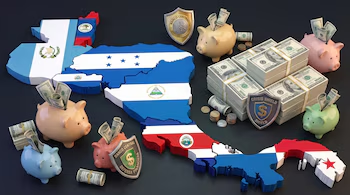
The Transformation of the Central American Financial System
Digitalization and Financial Inclusion
The Central American financial system is undergoing a transformative phase characterized by digitalization and a commitment to financial inclusion. Executives from the Ficohsa Group, a financial entity founded in Honduras in 1994 and now operating across six markets, including Guatemala, Nicaragua, and Panama, emphasize that the future of banking hinges on adaptability to economic and technological shifts. As reported by EFE during their 32nd anniversary celebrations in Tegucigalpa, Ficohsa leaders stress the necessity of evolving alongside global trends.
German Castaneda, Vice President of Corporate Communications, noted, “This world is evolving day after day, and we as an organization have the responsibility to evolve at the same pace or even faster to be able to anticipate all of this.” This statement encapsulates the urgency for financial institutions to stay relevant and cater to changing consumer needs.
Meeting Consumer Demands
Castañeda further highlighted the financial system’s pivotal role in regional economic development. As consumers increasingly demand more agile, secure, and accessible services, banks must innovate continuously to meet these expectations. “The financial system continues to be an engine in each of the countries where we operate,” he remarked, stressing the importance of consistent service across borders.
Digitalization has emerged as a core challenge in regional banking. People are looking for ways to enhance their lives and financial situations. As Castaneda indicated, “People’s expectations will always be focused on how to enhance their lives, how to enable them to prosper on the path to their future.”
Innovation at the Core of Growth
On its 32nd anniversary, Ficohsa reaffirmed its commitment to innovation as a key strategy for adapting to a dynamic financial landscape. Currently, the organization employs over 7,100 people, with 58% being women. Notably, there has been a 24% increase in women holding leadership positions in the past year, reflecting a positive shift toward diversity and inclusivity in the workplace.
Ficohsa’s regional outlook involves sharing knowledge and developing solutions that extend beyond traditional banking. The organization has expanded from a single country to six, providing insurance, pensions, and various financial services tailored to different life stages.
Bridging the Gap in Financial Services
One of Ficohsa’s primary goals is to reduce the disparities in access to financial services, especially in areas lacking sufficient banking infrastructure. The executive team stated, “We cannot grow transactionally; we cannot grow responsibly if we do not include communities.” This statement underscores their commitment to being transformative agents in the sphere of financial inclusion.
Ficohsa actively promotes education and entrepreneurship through initiatives like the Ficohsa Foundation, Mujeres Adelante, and De Mi Tierra, which aim to generate social impact across various sectors. Importantly, the organization also prioritizes ongoing training for its staff, with 95% undergoing training in ethics and anti-corruption, thereby contributing to a cohesive corporate culture across its international operations.
Conclusion
In summary, the Central American financial system, spearheaded by institutions like Ficohsa, is making significant strides in embracing digitalization and financial inclusion. By evolving to meet consumer demands and promoting equitable access to financial services, they are positioning themselves as essential players in the region’s economic development. As more technological advancements surface, the focus on innovation and inclusivity will undoubtedly define the future of banking in Central America.