
The Vacation Dilemma: Long vs. Short Breaks
In Spain, there’s a common debate around vacations that often leads to tension among coworkers: Is it better to take a long vacation of several weeks, allowing a complete mental reset, or is it wiser to spread out the legally mandated 30 calendar days of rest across the year with smaller getaways?
The Divide Among Vacationers
Your colleagues may have strong opinions on either side of the debate. However, when you turn to experts, the consensus becomes clearer. Doctor Antelm Pujol recently sparked conversation on this very topic through a tweet that has garnered widespread attention.
What Do the Experts Say?
Typically, workers in Spain are entitled to at least 30 calendar days of vacation. So, which approach is better for disconnecting? Should you spend three weeks in an exotic location like Cancun, or stagger your time off with several five-day trips?
Scientific Insights
Research indicates that segmenting your vacation time can yield better overall well-being. Doctor Pujol notes, “Taking more frequent vacations could be a better strategy to maintain well-being.” This viewpoint is supported by studies published in the Journal of Happiness Studies, which explored the health impacts of vacation durations.
Findings from Radboud University
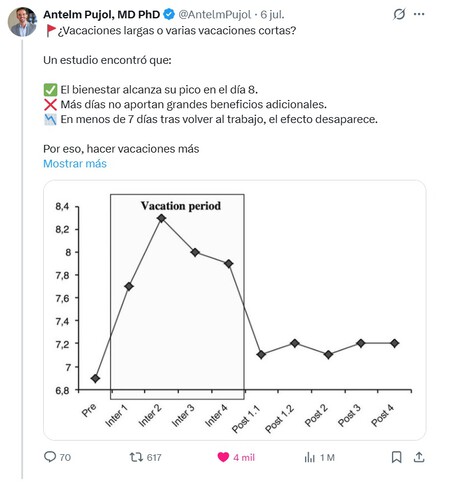
Researchers at the Radboud University focused on interview responses from workers who took vacations averaging 23 days. The results showed that happiness and well-being levels improved significantly in the first eight days of vacation, peaking around the fourth to eighth day. However, beyond this timeframe, the benefits plateaued.
Short Breaks for Better Health?
Post-vacation, many individuals experience a return to pre-vacation levels of health and well-being within a week. This insight raises an intriguing question: if a vacation’s benefits fade so quickly, wouldn’t it be more beneficial to take shorter, more frequent breaks instead?
The Expert Consensus
Experts like Marcos Vázquez argue that, “Short, frequent vacations have a more positive impact than long, infrequent vacations.” He emphasizes that significant well-being benefits can be achieved without taking an entire month off, suggesting that seven to ten days off more frequently may be optimal.
The Importance of Quality Sleep
Beyond vacation length, the quality of your time off also plays a crucial role. Participants in the Radboud study reported sleeping an average of 7.4 hours per night while on vacation, substantially more than their workday average of 6.7 hours. The correlation between quality sleep and well-being is evident.
Organizing Short Getaways
Planning multiple short trips rather than one extended stay allows for what psychologist Tim Sharp refers to as “anticipatory pleasure.” This means the excitement and enjoyment of planning can amplify the well-being experienced during the vacations themselves.
Final Thoughts
While the science leans towards the benefits of shorter, frequent vacations, personal preferences, logistical considerations, and the nature of your desired experience weigh heavily on the decision. Whether it’s a dream trip to Japan or nearby escapades, understanding one’s own priorities will guide the best vacation choices.