
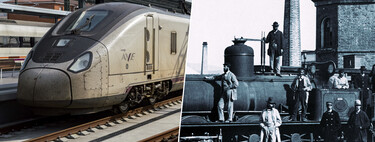
The State of Spanish Railways: Insights from César Franco
Recently, César Franco, an industrial engineer and director of the Master’s program in Industrial Engineering at the Universidad Alfonso X el Sabio, shared his views on the state of Spanish railways. Franco emphasizes the need to assess what has been done well, what hasn’t, and what steps can be taken for improvement.
A Shift in Infrastructure Investment
Franco notes a troubling trend: since 2008, especially from 2010 onwards, investments in infrastructure have declined, despite an increase of nine million people in Spain compared to the early 2000s. He attributes this downturn to a pendulum swing from overinvestment to a paralysis in new construction. “We moved from a period of oversizing to one of investment paralysis,” he explained, as excessive projections tainted the decision-making process.
The High-Speed Train Dilemma
The primary strategic error regarding the Spanish railway system has been the “all-or-nothing” mentality surrounding high-speed rail. The focus on achieving speeds exceeding 300 km/h often overshadows more practical solutions. “In many corridors, it would have been infinitely smarter and cost-effective to design a high-speed railway that facilitates 200 km/h operations,” Franco points out.
Infrastructure vs. Real Demand
Investment has primarily favored high-speed rail, with $55.9 billion allocated to it between 1990-2018, compared to just $3.6 billion for commuter services. The result? Major metropolitan areas—Madrid, Barcelona, Valencia, and others—are feeling the strain to accommodate growing populations.
New high-speed segments must pass a rigorous viability test: “Does it meet real demand? Is there a critical mass of passengers?” If it turns out we’d spend hundreds of millions for just a few trains per day, Franco asserts, “we’re making an economic error.”
Adapting to Modern Challenges
Franco highlights new challenges, especially the impact of climate change on infrastructure. With extreme weather events increasingly disrupting transport networks, standards from two decades ago can no longer suffice. The National Climate Adaptation Plan 2021-2030 calls for urgent reforms across the entire network to ensure resilience.
Lessons from Global Leaders
Franco advises looking toward countries like Japan and China for inspiration. Japan’s Shinkansen train system exemplifies meticulous maintenance and operational discipline, while China demonstrates the advantages of centralized planning and scale. However, Franco stresses, “The success of any rail system isn’t measured by theoretical maximum speeds but by reliability, safety, accessibility, and real utility for citizens.”
A Call for Comprehensive Planning
Ultimately, Franco believes Spain must transition from short-term project lists to long-term structural solutions. A coherent national infrastructure policy should consider comprehensive logistics chains that integrate transportation for people and goods, energy networks, and responses to climate resilience. He summarizes this vision succinctly: “The great problem that remains unaddressed is that goods don’t vote.” Thus, an overhaul is essential for Spain’s railway system to meet the evolving demands of its economy.