
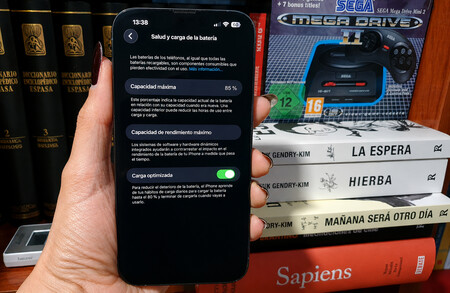
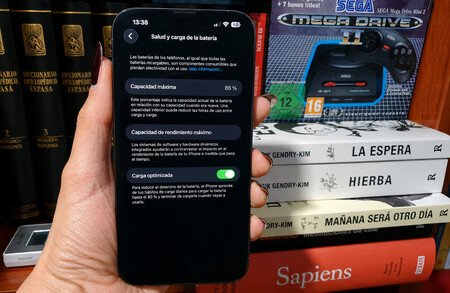
My smartphone, an iPhone 13 Pro Max, is almost five years old, and its battery still retains 85% of its original capacity. This is no coincidence or simple luck; it’s the outcome of understanding what happens to a battery comprising lithium ions every time we charge it, alongside applying specific habits that effectively slow down its degradation.
Many users believe that a mobile phone’s battery is bound to degrade beyond usefulness within two or three years, and to some extent, they’re correct. Every lithium-ion battery will lose capacity over time. However, the rate of this degradation largely depends on our treatment of the battery, not merely its inherent chemistry.
In this context, we need to focus on two critical factors: voltage stress and thermal degradation. These are the primary culprits that wear out battery cells. For nearly five years, I have adhered to certain guidelines that help minimize their impact. These are not mere tricks but are rooted in the electrochemistry within the battery.
What Happens to a Battery Every Time We Charge It
A lithium-ion battery functions by moving ions between the cathode and anode through an electrolyte. When we charge the phone to 100%, we force the cathode to reach its maximum voltage potential. This high voltage state oxidizes the electrolyte in contact with the cathode, facilitating the dissolution of transition metals from its crystalline structure, a phenomenon known as voltage stress. Importantly, this effect is cumulative: the longer the battery remains in a high voltage state, the more rapidly it degrades.
A quick note before we dive deeper: the layer that forms on the cathode is known as the CEI (cathode solid electrolyte interface). It is closely related to the SEI (solid electrolyte interface) that develops on the graphite anode. Under sustained high voltages, the CEI thickens uncontrollably, irreversibly consumes active lithium, and reduces the usable capacity of the cell with each charge cycle.
For this reason, I utilize the automatic 80% charging feature available on both iOS and Android. I generally avoid charging my phone to 100% unless I know I will require full battery life for the day. By keeping the battery in an intermediate voltage range (ideally between 20% and 80%), I significantly diminish the time the cells spend exposed to the extreme voltages where degradation accelerates.
The Impact of Heat on Battery Life
The second major adversary is heat, and this is where thermal degradation comes into play. Chemical reactions related to battery degradation do not rely solely on voltage; they also accelerate with temperature, and the relationship is non-linear. For example, a 10-degree Celsius rise in temperature can double certain degradation reactions in the electrolyte, corresponding with the Arrhenius equation that describes the kinetics of all chemical reactions.
This understanding is why I avoid ultra-fast chargers, especially during summer months or when my phone is exposed to the sun or enclosed in a thick case. Charging at high power levels (45, 65 watts, or more) generates significant internal heat. If that heat is not effectively dissipated—especially in environments exceeding 35 or 40 degrees Celsius—the cell’s temperature can reach 40-45 degrees Celsius. This range accelerates electrolyte degradation and cathode dissolution. Therefore, I favor slower charges at around 15 to 20 watts, even if they take longer; my battery appreciates this approach in the long run.
By adopting these habits, you too can extend the useful life of your battery, keeping it vibrant for years to come.