
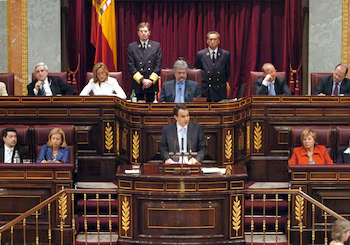
Zapatero’s Victory and Its Impact on Love and Family Planning
A recent study conducted by Pompeu Fabra University (UPF) and the University of Barcelona (UB) reveals a fascinating connection between the 2004 victory of the Spanish Socialist Workers’ Party (PSOE) and notable changes in the marital and reproductive choices of voters from the opposing Popular Party (PP). According to the findings published in the Journal of Population Economics, worsening economic expectations significantly shaped the life decisions of these PP supporters.
Analyzing the Data
To reach their conclusions, the researchers analyzed administrative records of abortions, births, and marriages in Spain from 2000 to 2020, particularly focusing on the aftermath of the 2004 elections. Utilizing a difference-in-differences methodology, they compared the shifts in abortion and conception rates in municipalities that strongly supported the losing party in the 2000 elections.
Key Findings
The findings were striking. One month post-election, municipalities that had predominantly supported the PP experienced a 0.05 increase in abortions per 1,000 women and a 0.14 decrease in monthly conceptions per 1,000 women. This dip in pregnancies coincided with a reduction in so-called “restorative marriages,” which typically occur following an unplanned pregnancy.
Political Shocks and Fertility Decisions
When Politics Meets Personal Choices
The study further identifies a direct link between political surprises and individual reproductive decisions. This phenomenon, previously observed in the United States after Donald Trump’s unexpected win in 2016, had not been quantified in Spain until now. The authors note that the government shift had an impact comparable to public policies like the 2,500 euro birth payment active between 2007 and 2010.
Economic Vulnerability Among Voters
The decline in birth rates among conservative voters is attributed to a “sharp and persistent decline in economic expectations.” Post-election surveys indicated a significant drop (between 0.6 and 0.8 points) in economic optimism among PP supporters, a drop more severe than that observed during typical economic transitions from growth to crisis.
The Role of Expectations
Interestingly, the effect of this political change was more pronounced when the electoral outcome was unexpected. Analysis of the 2011 elections, where a victory for the PP was anticipated, did not replicate the same impact on birth rates. However, the researchers acknowledge that further exploration is needed to understand the relative influences of economic expectations and other factors, such as shifts in political attitudes or anticipated policy changes.
Polarization’s Far-Reaching Effects
The researchers conclude that political polarization significantly divides citizens along party lines, impacting not just public opinion but also personal choices, particularly around fertility and marriage. This stark revelation underscores the broader implications of political shifts, suggesting that political landscapes can deeply influence personal lives beyond mere voting behaviors.
In summary, the intersection of politics and personal life decisions reveals a complex landscape where unexpected electoral outcomes can lead to significant changes in societal norms surrounding love, marriage, and family planning. As the political climate continues to evolve, the long-lasting effects on individual and collective behaviors warrant further examination.