
The Surprising Revelation Behind Rembrandt’s Altered Painting
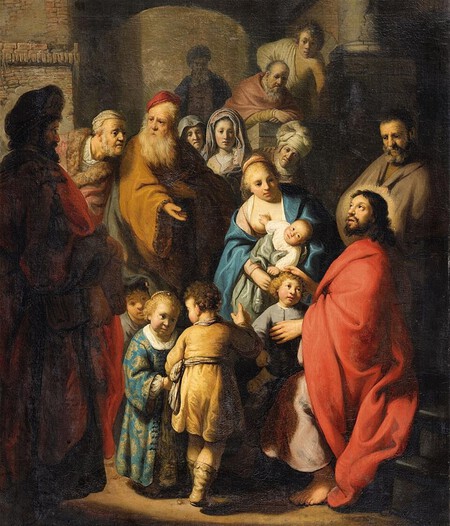
Rembrandt Harmenszoon van Rijn, a towering figure in baroque painting, continues to astonish art historians even more than 350 years after his passing. A remarkable incident in 2014 revealed one of his youthful works at an auction in Cologne, but it wasn’t until further restoration efforts that a hidden surprise emerged: beneath a layer of paint lay a figure of a man with dark skin, a black beard, and a large turban. This prompts the question: why was this figure obscured?
A Shift in Identity
This artwork, titled Let the Children Come to Me, likely created around 1627, initially passed under the radar for centuries. At the time of its auction, it was merely categorized as a piece from the “Dutch school,” fetching 1.5 million euros. However, subsequent research confirmed that it was indeed a Rembrandt, significantly increasing its value to between 9.3 and 14 million euros at a later auction.
The Unmasking of the Painting
Recent discoveries revealed that the current version of this painting is not purely Rembrandt’s handiwork but has been altered by a lesser-known hand, possibly that of Claes Cornelisz Moeyaert. Early evidence suggests that Rembrandt left the work partially unfinished, leading someone to finish it while altering the original design.
Technological advancements, including X-ray studies, have allowed experts to peel back the layers of paint, showcasing a significant transformation. The figure initially depicted as a man with a turban was turned into a venerable old man with a white beard and traditional Dutch cap. Why erase such a distinct portrayal?
Contextual Implications
The decision to modify the original artwork raises critical questions about historical context. Art historians suggest that Rembrandt’s depiction of a dark-skinned man in a turban was an intentional reflection of the rich, multicultural environment of 17th-century Leiden, marked by the arrival of thousands of refugees during the Thirty Years’ War. Historian Andrew Graham-Dixon emphasizes that Rembrandt might have sought to recognize and portray this humanitarian crisis, thus capturing the complex social fabric of his time.
Nevertheless, someone felt compelled to replace this figure with a more familiar character to the local populace, possibly reflecting prevailing attitudes toward ethnicity and inclusion during that era.
More Than Just a Painting
Rembrandt’s work was more than an artistic endeavor; it served as a visual narrative, commenting on humanitarianism. The biblical scene, depicting Christ welcoming children and families, was a subject of controversy, revealing community divisiveness regarding refugees. Rembrandt’s approach may suggest his moral stance on such issues, making the disappearance of the turban-clad figure even more poignant.
A Self-Portrait in Disguise
In addition to the altercations made to other figures, experts have discovered Rembrandt’s self-portrait hidden within the painting. His likeness appears, further deepening the personal connection between the artist and his work, as he often included family members and himself in his creations. This amalgamation hints at his desire to reassure his parents that their investment in his artistic training had paid off.
Conclusion: A Lasting Legacy
The alterations made to Rembrandt’s painting remind us of the complexities surrounding art, identity, and cultural representation. As we unveil more layers of history, the significance of what remains hidden becomes paramount. Understanding the narrative behind each brushstroke not only enriches our appreciation for the artwork but also encourages dialogue about the issues that resonate through time.
For more insights into this intriguing story, check out sources like Sotheby’s and The Guardian.