
Tour de France 2026: Key Dates and Overview
The Tour de France 2026 will take place from July 4 to July 26, marking its 113th edition. Participants will cover an impressive 3,333 kilometers with a staggering elevation gain of 54,450 meters throughout the race. This year’s route promises both challenges and excitement, setting the stage for intense competition.
Starting from Barcelona
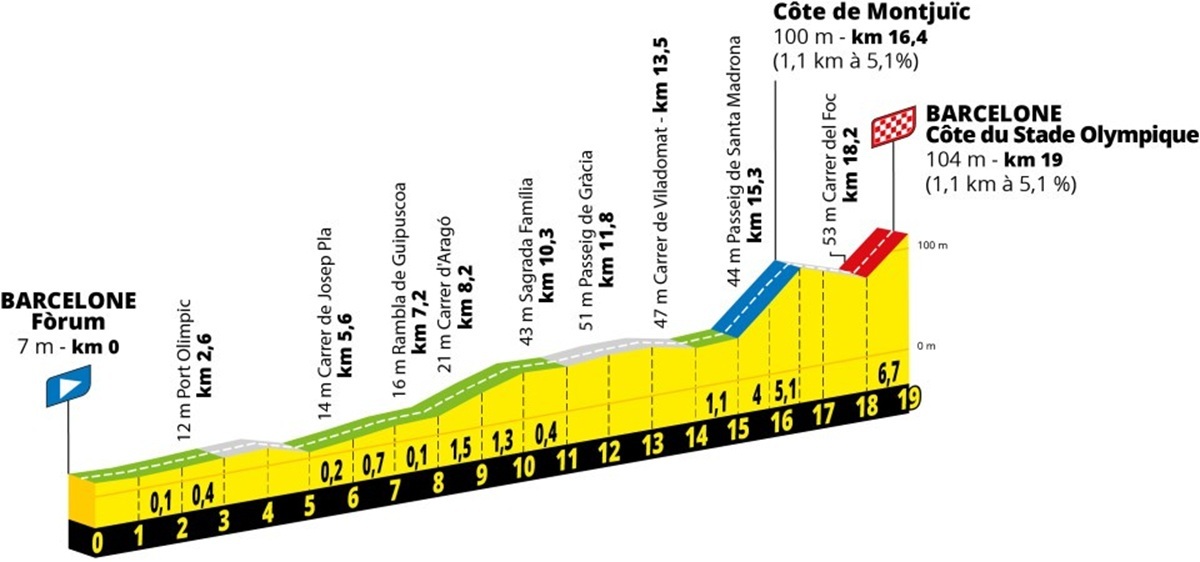
The race kicks off in Barcelona, featuring a 19-kilometer team time trial that ends at Montjuïc. This marks the third occasion Spain has hosted the opening stage, following San Sebastián in 1992 and Bilbao in 2023. Riders will face two additional stages in Catalonia: the second stage runs from Tarragona to Barcelona, and the third departs from Granollers, then crosses into France.
The Challenge Ahead
The route will gradually ramp up in difficulty, beginning with a challenging start in the Pyrenees just days into the competition. Riders will cross through all five major mountain ranges in France: the Pyrenees, Vosges, Massif Central, Jura, and Alps. The majority of the hurdles are concentrated in the final stages.
Stage Breakdown
- Total Stages: Seven flat stages, four medium mountain stages, eight high mountain stages (with five mountain finishes), and one short individual time trial of 26 kilometers.
- Final Stage: The grand finale occurs in Paris, featuring the demanding climb to Montmartre before heading to the Champs-Élysées.
This edition will introduce five new climbs: Côte Begues, Montée de Gavarnie-Gèdre, Col du Haag, and Plateau de Solaison. Notably, riders will ascend Alpe d’Huez twice, with the second ascent being the queen stage.
Detailed Stage Schedule
Here’s an overview of the stages:
July 4: Stage 1 – Barcelona to Barcelona (Team Time Trial), 19 km
Expect a fierce showdown as teams tackle a new format where individual times are counted in team time trials, revealing the strongest early on.
July 5: Stage 2 – Tarragona to Barcelona, 182 km
The last stages see powerful punchers vying for victory on the climactic Montjuïc slopes.
July 6: Stage 3 – Granollers (Spain) to Les Angles (France), 196 km
Anticipate intense competition in the Pyrenees, with late-stage action likely dictated by breakaways.
July 7: Stage 4 – Carcassonne to Foix, 182 km
This stage is likely to see a competitive tug-of-war between sprinters and attackers.
July 8: Stage 5 – Lannemezan to Pau, 158 km
Expect a sprint-friendly course, providing chances for speedsters to showcase their talents.
July 9: Stage 6 – Pau to Gavarnie-Gèdre, 186 km
A climactic stage featuring iconic climbs that could see battle lines drawn among the leading contenders.
July 10: Stage 7 – Hagetmau to Bordeaux, 175 km
Flat and fast, this stage is classic and is expected to culminate in a sprint.
July 11: Stage 8 – Périgueux to Bergerac, 182 km
Expect a return for sprinters, with a quick stage reflecting minimal elevation.
July 12: Stage 9 – Malemort to Ussel, 185 km
A stage for tough riders given the challenging terrain, likely favoring breakaway attempts.
July 13: Rest Day
July 14: Stage 10 – Aurillac to Le Lioran, 167 km
Key for climbers, particularly with the Col de la Griffoul presenting a new challenge.
July 15: Stage 11 – Vichy to Nevers, 161 km
Sprinters will look to capitalize here, but expect potential breakaways.
July 16: Stage 12 – Circuit Nevers Magny-Cours to Chalon-sur-Saône, 181 km
Expect a competitive environment with a focus on the sprinters.
July 17: Stage 13 – Dole to Belfort, 205 km
This lengthy stage, the longest of the tour, will likely see strategic racing.
July 18: Stage 14 – Mulhouse to Le Markstein, 155 km
A mountainous stage that introduces new gradients not previously tackled.
July 19: Stage 15 – Champagnole to Plateau de Solaison, 184 km
Prepare for tough climbs; this stage might decide the leaders for the general classification.
July 20: Rest Day
July 21: Stage 16 – Evian-les-Bains to Thonon-les-Bains (Individual Time Trial), 26 km
An explosive return featuring terrain that could suit some of the best climbers.
July 22: Stage 17 – Chambéry to Voiron, 175 km
Sprinters will thrive despite brief challenging climbs.
July 23: Stage 18 – Voiron to Orcières-Merlette, 185 km
The stage is set for climbers to battle for triumph leading into the closing stages.
July 24: Stage 19 – Gap to Alpe d’Huez, 128 km
A dynamic ascent promising high stakes for those daring to push forward.
July 25: Stage 20 – Bourg d’Oisans to Alpe d’Huez, 171 km
Regarded as the toughest stage, this setting contains formidable climbs likely to shake up the standings dramatically.
July 26: Stage 21 – Thoiry to Paris Champs-Élysées, 130 km
A traditional yet electrifying conclusion featuring iconic climbs, allowing sprinters one last shot at glory.
This year’s Tour de France promises a thrilling experience for fans and cyclists alike, showcasing the heart and grit synonymous with this legendary race.