
Sumar Urges Pedro Sánchez on Budget Proposals and Potential Elections
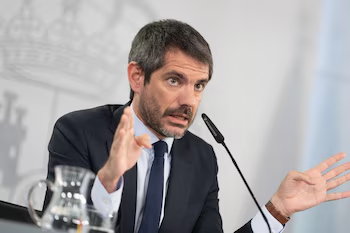
Ernest Urtasun, Spain’s Minister of Culture, has stated that it is “logical” to consider an electoral advance if Congress rejects the upcoming General State Budgets. This perspective aligns with recent remarks from Prime Minister Pedro Sánchez, who indicated readiness for elections depending on the budget negotiation outcomes.
Importance of the General State Budgets
Urtasun emphasizes the need for budgets that include a high spending ceiling and a fiscal policy aimed at rebalancing purchasing power. He advocates for increased taxation on the wealthiest, pointing out that 10% of the population controls 50% of the nation’s wealth. His assertions highlight Spain’s significant wealth inequality, ranking it among the European nations with the most skewed wealth distribution.
Moreover, Urtasun criticized the current tax framework, particularly the unresolved tax brackets, which perpetuate a rentier class that benefits at the expense of working-class wages. Addressing these issues should be a primary goal of the forthcoming budget.
Legislative Challenges Ahead
The recent Plenary Session of Congress saw the rejection of budgetary stability and public debt goals for 2026-2028, crucial steps for presenting the General State Budgets for 2026. This rejection adds urgency to the discussions surrounding the 2027 budgets. Prime Minister Sánchez affirmed that if the public accounts fail to gain approval, hard decisions will need to be made, although he refrained from jumping to conclusions during the budget preparation phase.
Connect Between Budgets and Legislative Continuity
For the first time, the continuity of Sánchez’s administration has been explicitly tied to the approval of budgets. He expressed his commitment to work diligently towards reaching a consensus with parliamentary groups, hoping to avoid unnecessary electoral complications. Notably, it has been over three years since new General State Budgets were presented, with only the 2023 budget being active as of now.
Urtasun also reiterated that the design of these budgets should not succumb to fears of parliamentary failure. He stated his willingness to engage in dialogue with major political parties, emphasizing the necessity of creating optimal budgets and fostering a robust parliamentary discussion.
Potential for Early Elections
Elma Saiz, Minister of Inclusion, Social Security, and Migration, hinted at the possibility of early elections if the budgets fail to pass. In her interviews, Saiz conveyed a pragmatic view—saying, “We neither assume nor discard” the idea of elections—while also reaffirming the government’s focus on pushing for the approval of the general accounts.
Conclusion: A Balancing Act Ahead
The next few months are crucial as negotiations over the General State Budgets unfold. If the government cannot secure the necessary parliamentary support, the political landscape in Spain could shift dramatically with early elections on the horizon. As Spain grapples with economic and social issues, the outcome of this budget discussion will likely shape the country’s future direction.