
Introducing GLM-5.2: A Game Changer in AI Models
A few days ago, the Chinese startup Zhipu AI (Z.ai) announced the launch of its new open AI model, GLM-5.2. This model boasts impressive features that align it closely with the best closed models from industry giants like OpenAI and Anthropic, a feat once deemed impossible. As analyses unfold, the consensus is clear: we may be at the dawn of a significant shift in AI capabilities.
Key Features of GLM-5.2
GLM-5.2 marks a remarkable improvement from its predecessors, showcasing a staggering 744 billion parameters, with 40,000 of them actively engaged. It features a context window of one million tokens and utilizes a new architecture called IndexShare/IndexCache. These advancements position it as a serious contender against leading models.
Performance Testing
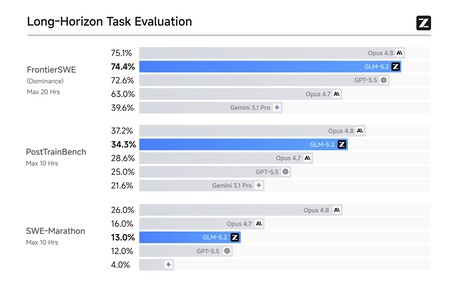
Better than GPT-5.5. In recent tests, GLM-5.2 has demonstrated extraordinary performance in programming tasks. In the rigorous FrontierSWE test, it outperformed GPT-5.5, with only Opus 4.8 slightly ahead. Similar results were observed in tests like PostTrainBench and SWE-Marathon, which assess the model’s capabilities during extensive programming sessions.
Source: Z.ai.
These results indicate a significant leap from version 5.1, with GLM-5.2 nearly equally competing with the best models from OpenAI, Anthropic, or Google.
Rankings and Comparisons
According to Artificial Analysis, a reputable independent firm, the “intelligence index” for GLM-5.2 stands at 51 points, trailing only behind GPT-5.5 (55), Claude Opus 4.8 (56), and Claude Fable 5 (60). This model has overtaken recent models like Gemini 3.5 Flash and Chinese competitors such as Qwen 3.7 Max.
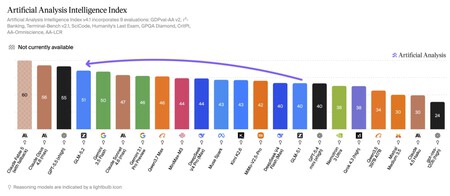
Source: Artificial Analysis.
Price Efficiency
One of the standout features of GLM-5.2 is its pricing model. It maintains the cost per million input/output tokens of its predecessor at $1.4/4.4, significantly lower than GPT-5.5 versus $5/30 and Opus 4.8’s $10/50. Despite being more token-consuming, its overall efficiency keeps final costs markedly lower.
User Experience and Practical Applications
Programming with GLM-5.2. I’ve had the opportunity to test GLM-5.2 extensively. In my experience, it allowed for an impressive review of my personal coding projects, identifying security flaws and suggesting detailed improvements.
Conversational Abilities
While GLM-5.2 excels in programming, its conversational abilities may lag behind. Although improvements from GLM-5.1 are notable, its creativity still seems inferior compared to the frontier models of Google and OpenAI. Users have reported variations in response times, indicating a longer reasoning process compared to other models.
On forums like Reddit, opinions about GLM-5.2 are divided, but many users regard it as a fantastic option for local use, assuming sufficient computational power.
Conclusion
Overall, GLM-5.2 emerges as a formidable competitor in the AI landscape, showcasing robust capabilities at a competitive price. While it may still have areas needing refinement, particularly in conversational quality and reliability, the advancements it brings are significant for the future of AI technology.