
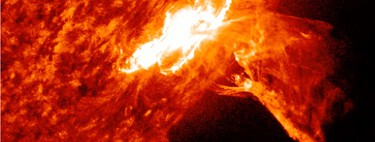
Revolutionizing Solar Flare Predictions
Predicting solar flares has long been a significant challenge for scientists. Traditionally, researchers have relied on high-resolution instruments to monitor the propagation of coronal mass ejections (CMEs)—massive bursts of solar wind and magnetic fields rising above the solar corona or being released into space. However, this reactive approach often lacks the time needed for actionable responses on Earth. Fortunately, a breakthrough from scientists at the New Jersey Institute of Technology offers new hope in predicting these powerful solar events before they occur.
Identifying Key Plasma Changes
The groundbreaking study has pinpointed three critical parameters that indicate a solar flare’s impending arrival. According to the research, in the three hours leading up to a solar flare, there are notable changes in:
- Brightness: An increase in the brightness of specific regions in the solar atmosphere.
- Movement: Observed movement of plasma either towards or away from the observer.
- Non-thermal Speed: A measurement of turbulent changes and low-scale motions within the plasma.
Researchers have noted that these parameters tend to spike, accompanied by cyclic patterns that last between 18 to 21 minutes. While this phenomenon has only been documented before a singular flare so far, the possibility of replicating these observations across future flares could herald a new era in solar forecasting.
The Right Tools in the Right Place
To make these observations, the scientists utilized the Interface Region Imaging Spectrograph (IRIS) from NASA. This instrument specializes in analyzing narrow segments of the solar atmosphere and proved invaluable in studying an area recently characterized by multiple solar flares. The fortunate alignment of advanced technology and an active solar region allowed scientists to capture these crucial data points.
Understanding the Risks
Solar flares are explosive events characterized by bursts of electromagnetic radiation. Often accompanied by solar flares, these eruptions eject massive amounts of electrically charged particles into space. When these particles interact with Earth’s magnetosphere, they can either be deflected or penetrate through it, leading to various phenomena such as breathtaking auroras and potentially dangerous geomagnetic storms. While these events generally do not threaten human safety directly, they can disrupt telecommunications and other critical infrastructures.
Future Research Directions
Despite this promising discovery, the scientific community still has many questions to answer. Specifically, researchers need to understand why these plasma changes occur immediately before a solar flare. Further studies are crucial to determine if these patterns are consistent across multiple solar flares, which would significantly enhance our forecasting capabilities. A predictive model could save valuable time and resources, potentially transforming how we manage the risks posed by geomagnetic events.
Image | POT
In Xataka | A sunspot 17 times larger than Earth caused red auroras across half the world. It is a very rare event.