
The Mysterious Christmas Tree Fighter: A Revival of an Old Concept
Strange Sightings at Area 51
In the summer of 1955, residents of Nevada began reporting unusual aerial phenomena. These sightings were later acknowledged in declassified CIA documents, revealing that many of these supposed UFOs were, in fact, secret prototypes tested at Groom Lake—better known today as Area 51. The interest surrounding this enigmatic facility continues to grow, especially with the recent emergence of peculiar thermal images.
A Blurred Image and Forgotten Technologies
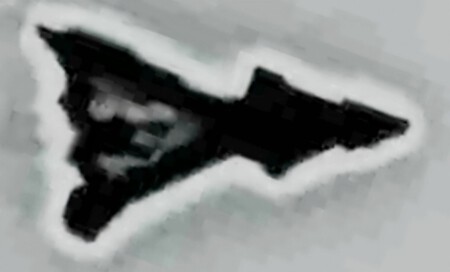
Recently, a thermal capture emerged from the vicinity of Area 51, showcasing an unusually shaped aircraft that appeared to be tailless, featuring large front canards and unconventional wings. Due to the low quality of the video, definitive identification remains elusive; however, it sparked a wave of speculation among aviation enthusiasts and experts alike.
This time, the silhouette has reignited interest in a concept that had languished in obscurity since 1983: the so-called “Christmas Tree Fighter,” a design initially conceived for stealth capabilities.
The Christmas Tree Fighter Resurfaces
Developed by Darold Cummings, an engineer involved in the YF-23 jet’s development, this radical design aimed to minimize radar signatures dramatically. Dubbed the DP-21, the aerial vehicle was characterized by its extreme geometric shape; its innovative design was so unconventional that experts deemed it impractical.
The Technological Barriers of the Past
Cummings’ vision boasted a configuration aimed at achieving minimal radar reflection, reminiscent of the B-2 bomber. However, the flight control technology available in the 1980s proved inadequate for managing such an unstable aircraft. As a result, the Christmas Tree Fighter concept was shelved, relegated to the annals of technical curiosities.
Resemblance to Modern Designs
The recently captured thermal image shares several design elements that echo the DP-21. Notably, it features a “double arrowhead” shape in its front section, lacks traditional tail surfaces, and exhibits an unconventional distribution of wings and fuselage. While it remains undetermined if the newer aircraft is a direct descendant of Cummings’ project, the parallels are striking.
Connections to the F-47 Project
The prevailing theory suggests a link between the observed aircraft and the upcoming F-47 fighter program. Elements in the thermal image—such as large canards and a configuration optimized for stealth—align closely with designs revealed in official program documentation. Some researchers have even pointed out that the silhouette resembles patterns hidden in a unit patch associated with the F-47, emphasizing a historical penchant for obscuring clues within military insignia.
An Evolution of Stealth Technologies
The aircraft likely draws inspiration from a range of experimental projects, including Boeing’s X-36 and the Bird of Prey programs. Both sought to harness unconventional configurations while minimizing radar visibility. Technologies salvaged from these earlier endeavors appear to have evolved clandestinely and may now be manifesting in this new aircraft design.
Unsolved Mysteries Ahead
Ultimately, the true identity of the aircraft captured in the thermal image remains uncertain. It could represent a prototype for the F-47, an F/A-XX naval fighter, a Northrop Grumman project, or an entirely different experimental platform. What is evident is that this captivating image has revitalized interest in what many considered a mere footnote in aviation history.
In conclusion, forty years after it was initially proposed, the concept of the Christmas Tree Fighter may not just be a relic of the past, but a precursor to the technologies and designs that might define future aerial combat strategies. The revelation points to a remarkable evolution of ideas that, once thought implausible, are now on the verge of becoming reality.