
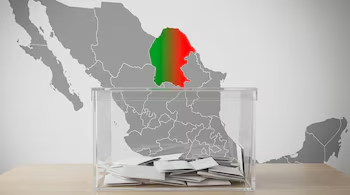
Coahuila Elections 2026: Results and Overview of the PREP
The elections in Coahuila held on June 7, 2026, were pivotal for the state’s political landscape. This was the only election in Mexico that year aimed at renewing the local congress, with 25 deputies on the line and about 2.4 million registered voters. The election was closely watched, especially as the PRI-UDC coalition emerged victorious across all 16 districts.
Citizen Participation and New Technologies
Voter turnout for this election exceeded 50%, significantly higher than the 39% recorded in the 2020 local elections. As part of this process, the INE (National Electoral Institute) implemented a pilot test known as the Electronic Counting and Counting Table (MEC). This technological advancement aimed at ensuring the accuracy and legality of online votes, marking a significant step in modernizing Mexico’s electoral processes.
Preliminary Results
As of the early morning of June 8, with 94.37% of the votes captured, the preliminary results were as follows:
- PRI – UDC: 654,218 votes (54.98%) — 16 districts
- PT – Morena: 310,970 votes (26.13%) — 0 districts
- New Ideas: 70,899 votes (5.95%) — 0 districts
- Green Party: 31,053 votes (2.60%) — 0 districts
- PAN (National Action Party): 25,426 votes (2.13%) — 0 districts
- Citizen Movement: 23,898 votes (2.00%) — 0 districts
- Mexico Avante: 6,823 votes (0.57%) — 0 districts
- Unregistered Candidates: 2,496 votes (0.20%)
- Null Votes: 61,744 (5.18%)
The total votes cast amounted to 1,189,875, highlighting the significant engagement of Coahuila’s citizens in this election.
Peaceful Elections Amidst Controversy
Miguel Castillo Morales, the president of the Local Council of the INE in Coahuila, reported that the elections were conducted peacefully with only minor isolated incidents. All 4,275 polling stations were successfully installed without serious disruptions.
However, the elections were not without contention. The national president of Morena, Ariadna Montiel Reyes, claimed a systematic operation of vote buying occurred, termed “QRgate.” Allegedly, citizens received QR codes that needed to be photographed next to marked ballots to receive cash incentivizing their votes for the PRI.
Legal Actions and Accusations
Montiel Reyes announced that Morena would pursue multiple legal avenues against electoral irregularities. Complaints were filed with the Electoral Institute of Coahuila, and there are plans to investigate the alleged vote-buying scheme through various authorities, including the Cyber Police.
Looking Forward: The Future of Coahuila’s Political Scene
PRI leaders, including Carlos Robles Loustaunau and Alejandro Moreno, celebrated what they termed an overwhelming victory. Moreno emphasized that this result serves as a message for the upcoming elections in 2027, asserting the PRI as the main opposition party.
In his statements, Moreno hinted at future political battles, asserting that the people’s will would not be undermined by government power or financial influence. As Coahuila moves toward its next electoral cycle, the events of June 2026 will undoubtedly shape the political narrative in the state.
Conclusion
The results from Coahuila signify a decisive moment in Mexican politics, reflecting both the consolidation of the PRI’s power and the growing challenges posed by allegations of electoral misconduct. The next few years will be crucial as allegations are investigated and political factions prepare for future contests, particularly in 2027.