
The Disturbing Origins of Alien
One of the most haunting inspirations for Alien did not arise in a Hollywood studio but rather in a doctor’s office. Screenwriter Dan O’Bannon’s struggle with Crohn’s disease led him to describe episodes as the sensation of something alive trying to break free from within him. This deeply personal experience became the seed for one of the most iconic and disturbing images in cinematic history—the chestburster scene.
A Game-Changer in Horror
In 1979, Ridley Scott made the unconventional decision to conceal much of the film’s pivotal moments from the actors themselves. Believing that genuine fear could never be replicated on cue, he opted to keep the script vague, only hinting that “something emerges.” The exact design of the creature, the volume of blood, and the scene’s violent execution were unknown to most of the cast. This commitment to surprise birthed one of the most shocking sequences in film history, setting a new benchmark for horror.
The Birth of a Nightmare
The infamous chestburster scene was more than just creative imagination. O’Bannon was intrigued by parasites and the gruesome reproductive mechanisms found in the insect world. He took inspiration from wasps laying eggs inside other animals and larvae growing within live hosts. Coupled with his own painful experiences of Crohn’s disease, the concept of an interior struggle gave rise to a monster that ultimately terrified audiences.
Finding the Perfect Design
Once O’Bannon’s concept was established, he knew the creature needed a compelling visual representation. His earlier work on a failed adaptation of Dune led him to discover the surreal artwork of Swiss artist H.R. Giger. Giger’s biomechanical aesthetics, which interwove themes of sexuality, death, and machinery, captured Scott’s imagination. Despite initial resistance from producers, Scott’s endorsement of Giger’s visionary designs was pivotal in cementing the visual identity of Alien, which influenced nearly all subsequent science fiction.
Nature-Inspired Horror
O’Bannon’s vision extended beyond a mere monstrous alien. He aimed to create a life cycle for the creature that was as disturbing as it was believable. The facehugger, responsible for implanting embryos in its victims, was conceived from a combination of O’Bannon’s ideas and Giger’s designs. This hybrid organism showcased frightening behaviors observed in nature, emphasizing themes of bodily autonomy and the horror of becoming a vessel for something alien.
Crafting the Unforgettable Shock
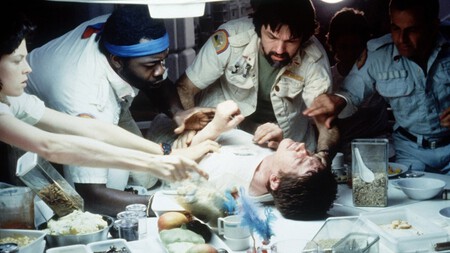
Scott understood that the alien birth sequence would be crucial to the film’s success or failure. To ensure maximum impact, he meticulously designed the scene, using a realistic artificial torso for actor John Hurt. Real animal organs were used to create an authentic texture, contributing to a mise-en-scène so intense that crew members later recalled the pungent odors of formaldehyde and rot that permeated the set.
Keeping Secrets from the Cast
The actors were aware that something would emerge from Kane’s chest, but the full extent of the scene remained a mystery. When they entered the set, covered in plastic and filled with mysterious equipment, tension hung thick in the air. This uncertainty was a deliberate tactic by Scott, aimed at capturing authentic, unscripted reactions during filming.
Authentic Reactions, Lasting Impact
Filming was fraught with challenges, including mechanical failures that only heightened the actors’ anxiety. When the chestburster finally emerged, real terror gripped the cast. Veronica Cartwright and Sigourney Weaver both expressed that their reactions were influenced by genuine concern for John Hurt. The moment of shock played out vividly on screen, largely due to the actors’ authentic responses to the unexpected displays of horror.
A Scene Forever Imprinted in Film History
Scott’s approach yielded the visceral, frightening impact he desired. The stunned expressions and sheer horror captured during the scene are now iconic. Decades later, it remains impactful, tapping into deeper fears about bodily autonomy and the unknown.
A Legacy of Fear and Innovation
The significance of this scene transcends mere effects. Alien redefined how cinema portrayed extraterrestrial life, introducing a new form of biological horror. It solidified Ridley Scott’s status as a pioneering director while making H.R. Giger a celebrated figure in film design. The most effective nightmares often originate from our real fears, and Alien showcased that philosophy effectively.
With a passionate screenwriter, a visionary artist, a determined director, and an unsuspecting cast, Alien continues to incite fascination and fear nearly half a century later—proof that, sometimes, the most terrifying elements in film are rooted in the reality of our own experiences.