
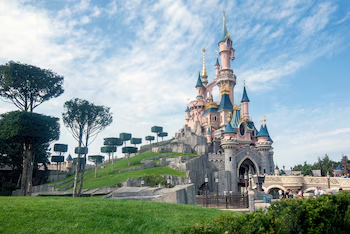
Disneyland Paris: A Financial Dilemma After 30 Years of Operation
Disneyland Paris, which opened its doors on April 12, 1992, remains a significant topic of discussion for both fans and financial analysts alike. Despite being the highest-performing international subsidiary of The Walt Disney Company, the park has not yet recovered $4.2 billion of its initial investment, equating to about €3.6 billion. This article delves into the financial complexities, historical challenges, and current profitability of Disneyland Paris.
Financial Overview
The park, located in Marne-la-Vallée near Paris, attracts approximately 16 million visitors a year. In the fiscal year ending September 30, 2025, Euro Disney Associés (EDA) reported record revenues of $4 billion (€3.4 billion), marking an 8.4% increase compared to the previous year. The net profit saw substantial growth, reaching $304.2 million (€260 million), nearly three times the profits reported in the prior year. These results contribute to 40% of the group’s global revenue and 57% of its total operating profit of $17.6 billion.
Accumulated Losses Plaguing the Park
Despite these impressive figures, the long-term outlook remains grim. EDA has recorded net profits in only 13 out of 30 years, amassing combined losses of $3.7 billion (€3.3 billion) since its inception. This persistent financial strain is attributed to various factors, precluding a complete recovery of initial investments.
Historical Context and Investment Structure
The problems can be traced back to the original negotiations with the French government, which required Disney to take the company public. This structure left Disney with only 49% of the capital, thereby restricting its ability to contribute significantly to the project. Of the $4.9 billion cost to build Disneyland Paris, 59.8% was financed through bank loans, while Disney contributed a mere $132.1 million from its capital. A warning from then-president Philippe Bourguignon in 1993 highlighted the precarious nature of EDA’s financial structure, stating it could jeopardize the company’s existence.
External Challenges Contributing to Financial Strain
The park launched during the 1994 economic recession, and challenges persisted. For instance, the second theme park’s opening in 2002 coincided with a downturn in international tourism following the September 11, 2001 attacks. The most crucial setback occurred in 2016 when EDA recorded a staggering net loss of $961.8 million (€858 million) due to a decline in visitors following the November 2015 terrorist attacks in Paris. The COVID-19 pandemic followed, halting a brief period of profitability.
Strategic Moves for Recovery
In 2017, Disney took decisive action by acquiring 100% of the shares for $250.8 million and delisting the company from Euronext, thereby enabling complete control and the restructuring of debt that required an additional $1.7 billion investment. Since its opening, Disneyland Paris has only distributed one dividend, in 1993, which yielded Disney just $10.2 million.
Future Prospects and Developments
Looking ahead, in March 2026, new Disney CEO Josh D’Amaro, alongside French President Emmanuel Macron, inaugurated the largest expansion in the park’s history: Disney Adventure World, featuring a themed area inspired by Frozen, representing a total investment of $2.5 billion. This brings Disney’s total investment in Disneyland Paris to $6.8 billion (€5.7 billion). However, challenges loom as ongoing conflicts, such as the war in the Middle East, have led to rising petroleum prices, potentially affecting tourist influx.
Conclusion
Disneyland Paris remains a complex case of high potential and acute financial challenges. Despite its status as a profitable entity for Disney globally, the park’s struggle to recover its initial investment paints a stark picture of the risks and rewards associated with monumental ventures. As new expansions roll out, the focus will be on whether these efforts can ultimately lead to long-term financial stability.