
Understanding Spain’s Housing Paradox
In early 2026, Spain’s real estate market exhibits a perplexing contradiction: falling sales coupled with rising prices. Despite a significant drop in transactions at notary offices—indicating a cooling demand—the average property price continues to rise sharply, achieving double-digit growth rates not seen in years.
Declining Sales Figures
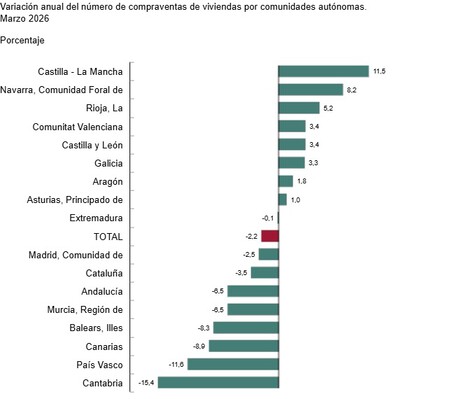
The first quarter of 2026 reported a 2.6% decline in home sales compared to the same period in 2025, according to the National Institute of Statistics (INE). As a reflection of this trend, March alone saw around 61,295 transactions, a stark drop from previous years. Even in high-demand regions like Madrid and Catalonia, decreases were recorded, with notable declines reaching 11.6% in some areas.
Rising Prices Despite Fewer Transactions
Conversely, while sales stall, property prices are on the rise. The Ministry of Housing indicated that the average cost per square meter surged to €2,315.7—an impressive 3.8% increase within just three months and a remarkable 13.9% rise year-on-year. New constructions have similarly seen inflated prices, with increases of 12.8% for properties less than five years old and 13.8% for older properties.
The Regional Snapshot
Market performance varies by location. Some regions, like Castilla-La Mancha, saw increases in transactions, while others faced significant declines. In general, declining sales are not uniform across the country, suggesting localized market dynamics affected by factors such as geographic desirability and economic conditions.
Why Are Prices Still Rising?
Despite the apparent slowdown, several compelling reasons explain why prices continue to escalate:
Housing Shortage: A deficit of approximately 700,000 homes currently exists in Spain, intensifying pressures on the market. The construction of new homes remains sluggish relative to the rising number of households, leading to a persistent imbalance between supply and demand.
Escalating Construction Costs: The construction sector is grappling with rising costs. Issues such as labor shortages and inflation in materials further contribute to the increasing price of new builds, creating a backlog of supply.
Investor Attraction: Real estate remains a sought-after asset for investors despite rising prices. Enhanced demand from investment-driven buyers sustains price levels, even when overall buyer activity decreases.
What Lies Ahead?
Looking forward, experts like José García Montalvo suggest that the market must reach a buyer-seller equilibrium for any substantial price corrections to occur. As sellers begin to adjust their expectations in response to buyer constraints, it is anticipated that a more balanced pricing landscape could emerge.
Conclusion
In summary, the Spanish housing paradox—where sales are declining yet prices continue to soar—illustrates a complex interplay of market forces, including supply bottlenecks, escalating construction costs, and ongoing investor interest. Observing how these dynamics unfold will be crucial for buyers, investors, and policymakers aiming to navigate the evolving landscape of Spain’s real estate sector.