
José Daniel Ferrer’s Vision for Cuba: Lessons from Venezuela
A Call for Forceful Change
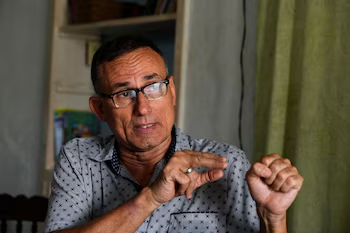
Cuban opposition leader José Daniel Ferrer boldly argues that the strategies employed by the United States to oust former Venezuelan dictator Nicolás Maduro could serve as a model for the Cuban context. In his view, the urgency to remove the current regime calls for decisive action, stating, “We see no other option than to remove the regime by force.” Ferrer believes that Cuba would witness a rapid political transition once the oppressive Castro regime is dismantled.
Internal Pressure and Growing Discontent
Ferrer, the head of the Patriotic Union of Cuba (UNPACU), highlights the unbearable internal pressure stemming from decades of repression and deprivation. After enduring imprisonment during the Black Spring of 2003 and subsequent arrests following the protests of July 2021, Ferrer currently resides in the United States. Despite his exile, he voices the cries of a Cuban society engulfed in “oppression and extreme misery,” particularly for political prisoners.
Recent assessments indicate that two-thirds of the Cuban population supports regime change, both from within the island and from the diaspora. Ferrer posits that the Venezuelan transition, where Maduro’s arrest paved the way for Delcy Rodríguez with U.S. support, is “replicable” in Cuba and could occur even more swiftly due to the immense frustration and exhaustion among Cubans.
Signs of Regime Weakness
The intensity of Cuba’s political and economic crises has begun eroding support for the regime, even from elements within the Communist Party. Ferrer notes that military personnel, especially those ranked mid to low, are increasingly disenchanted with the authorities. He asserts that many are reluctant to defend a government they view as detrimental to their well-being.
The Advantage of Disunity
Ferrer points out that Castroism’s foundations are frail, held together primarily by terror, fear, and distrust. High-profile former officials have been ousted in the past for losing favor, and with current conditions indicating imminent collapse, Ferrer anticipates a similar fate for contemporary power brokers.
Interestingly, Ferrer argues that Cuba’s opposition landscape—lacking a robust established network—could become an advantage compared to Venezuela’s prior dynamics. He underscores the existence of a politically and economically potent Cuban exile community that maintains strong ties with internal dissidents.
Strengthening Alliances and Resistance
The budding relationship between those in exile and opposition members within Cuba is becoming more secure. Ferrer lauds Marco Rubio, the American Secretary of State, as a significant ally, stressing his unwavering focus on Cuban issues as a personal priority. Ferrer maintains “constant and fluid” communication with Rubio and the State Department, sharing ideas with fellow dissidents both within and outside Cuba.
The Regime’s Impending End
Ferrer is convinced that the current regime is “sentenced” and anticipates a major turning point in the near future. With growing dissent driven by economic hardships, political persecution, and a unified internal-external opposition, the prospects for a political transition in Cuba appear more promising than ever.
As Ferrer continues to lead and galvanize support among Cubans and influential figures in Washington, the stage is set for significant change. The time for transformation may indeed be imminent, drawing lessons from Venezuela’s past and tailoring them to Cuba’s unique situation.