
Requirements for Electoral Reform
Any electoral reform must satisfy three key criteria, as it requires a special majority—half plus one of the members in both chambers of Congress.
Future-Oriented State Policy
Firstly, such reforms should generate state policy looking to the future, particularly in enhancing electoral processes. This long-term vision is crucial for creating stability and trust within the electoral system.
Statesmanship Over Political Speculation
Secondly, it’s vital that the proposal emanates from a statesmanlike perspective rather than short-term political maneuvering. Reform should not merely serve the interests of specific parties; it needs to be about the greater good for the country.
Building Consensus
Lastly, any reform must foster broad consensus among political parties, congressional representatives, specialists, and NGOs involved in electoral matters. Without this cohesion, the reform risks looking like an attempt to marginalize opponents and solidify power.
The Removal of PASO: A Brief Overview
The proposed removal of Open, Simultaneous and Mandatory Primaries (PASO) raises significant concerns. In the current state of electoral disarray in Argentina, PASO has served as an organizational tool for coalitions and candidacies.
PASO as a Preventive Mechanism
The assertion that PASO has not been useful is misleading. In various instances, where PASO was absent, it served as a preemptive measure for coalitions to reach agreements. This dynamic cannot be understated.
The Importance of the Obligatory Nature of PASO
It’s also critical to remember that PASO should remain obligatory, especially in smaller provinces or municipalities. Without this obligation, there’s a risk that a partisan electorate may manipulate candidate selection, fostering an environment where only weak competitors emerge.
Single Paper Ballot (BUP) and its Implications
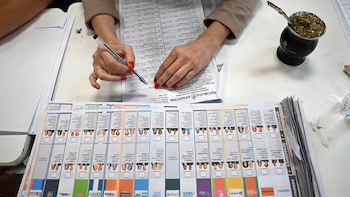
The Single Paper Ballot (BUP) has gained popularity as a voting system, eliminating confusion on election day by presenting all candidates in one place. Proposals allowing for complete voting buttons should be carefully evaluated, emphasizing transparency and clarity.
Presidential Debates
Mandatory presidential debates are essential. This ensures that all candidates participate, promoting accountability and fairness—a cornerstone of a democratic society.
Challenges in Political Party Formation
Increasing the threshold for political party formation from 5 to 10 members serves as a limitation to free association, stifling the ability of new or smaller parties to compete. This change could infringe upon the foundational principle of voter choice.
Conclusion
Ultimately, any electoral reform in Argentina should be seen as a means to bridge two fractured domains: the so-called “republicanism” around the official party and Justicialism with its affiliates. Ensuring that these reforms are transparent and serve the electorate is paramount. Only through rigorous dialogue and thoughtful legislation can we hope to achieve an electoral system that is fair, equitable, and enduring.