
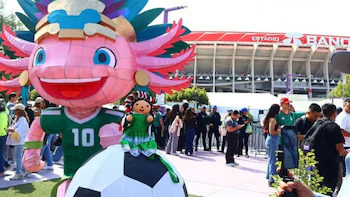
Government of CDMX Clarifies: No FIFA Order to Remove Monumental Axolotl
The government of Mexico City (CDMX) has firmly denied claims that FIFA ordered the removal of the monumental axolotl statue located on the pedestrian bridge connecting Cetram Huipulco with the Mexico City Stadium, a key venue for the upcoming 2026 FIFA World Cup. This confirmation was shared on social media, directly countering the speculation circulating online.
Official Statement from CDMX
In an announcement made via their official X account, the government stated, “FALSE. The Government of Mexico City categorically denies the information circulating about the alleged order from @fifacom_es to remove the sculpture of the axolotl in the vicinity of the Mexico City Stadium. There is no action to remove, restrict or modify it. This element is part of the identity of our city.” This statement reinforces the axolotl’s significance as a cultural icon for both the local community and visitors.
Origin of the Controversy
The notion that the axolotl might be removed likely stems from a column by journalist Javier Tejado. He highlighted potential restrictions based on commercial agreements involving Mexico, the United States, and Canada, designed to safeguard official tournament branding.
Clarification by Intellectual Property Authorities
Carolina Pérez Luna, divisional director of Intellectual Property Protection at the Mexican Institute of Industrial Property (IMPI), further clarified the situation in an interview. She explained that while the axolotl is a symbol of Mexico City’s identity, it doesn’t currently hold a trademark status. Moreover, she stated, “If they wanted to register it as a trademark they could, but in reality, the axolotl would not be identified as a World Cup mascot for FIFA events.” This statement highlights the intent behind FIFA’s registration of brands and mascots but doesn’t specifically target the axolotl.
FIFA Mascots and Branding Restrictions
FIFA has officially registered three mascots for the 2026 World Cup: Maple, Zayu, and Clutch. Pérez Luna emphasized that the restrictions involve all potential mascots, indicating that it is not exclusive to the axolotl. Rather, FIFA operates under an accreditation scheme that permits only these three characters as authorized symbols during the tournament.
The Broader Context: Axolotization and Cultural Identity
The discussion surrounding the axolotl transcends mere branding; it encompasses a significant cultural icon linked to Mexico City’s identity and heritage. The term “axolotization” has arisen, reflecting the increasing presence of axolotl imagery in urban spaces, largely driven by the local government’s efforts under City Mayor Clara Brugada. This initiative involves murals, sculptures, and other artistic representations of the axolotl, which Brugada has utilized to revitalize public spaces and foster a sense of local pride.
Brugada has been clear in her vision: “If axolotizing means filling with color what was previously gray, then of course we are axolotizing.” This assertion captures the spirit of transforming urban environments while underscoring the cultural resonance of the axolotl as an emblem of resilience and identity in Mexico City.
Conclusion: A Symbol of Identity, Not a Tournament Mascot
In summary, the monumental axolotl will remain in its place, undisturbed by FIFA’s commercial agreements. Its continued presence underlines its importance as a cultural symbol that represents the heart of Mexico City—inviting residents and visitors alike to celebrate this unique aspect of local heritage during the global spotlight of the 2026 FIFA World Cup.