
Buenos Aires Hosts the IFNE + GLEN International Congress
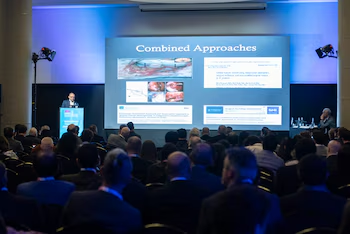
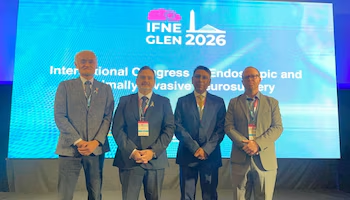
Buenos Aires recently emerged as a pivotal global hub for neuroendoscopy, hosting the IFNE + GLEN International Congress. This landmark event marked the first of its kind in Argentina, attracting over 150 specialists who showcased cutting-edge developments in medical technology and minimally invasive surgical techniques, thereby enhancing regional prominence in neurosurgical innovation.
Innovations Showcased at the Congress
Key advances presented included the integration of 3D printing and virtual reality to enhance surgical training, innovative methods for addressing complex brain injuries, and minimally invasive approaches for treating hydrocephalus. Additionally, the congress explored the role of robotics in neurosurgery coupled with assisted navigation systems. New diagnostic tools, such as infrared fluorescence and real-time molecular analysis, were also highlighted for their potential to bolster clinical accuracy and patient outcomes.
Training and Technology in Neuroendoscopy
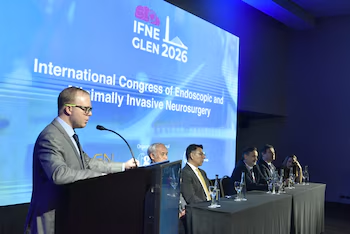
The congress, organized by the Garrahan Foundation, in collaboration with the International Federation of Neuroendoscopy (IFNE) and the Latin American Group of Neuroendoscopy Studies (GLEN), featured a comprehensive agenda designed to expand beyond traditional presentations. Notable contributions included 3D printed training models that simulate neuroendoscopic procedures, allowing for improved practitioner readiness.
Experts highlighted how simulations reshape conventional training pathways, pioneering safer surgical practices and delivering superior patient outcomes. Such innovations were central to discussions and workshops, emphasizing the digital transformation within medical education.
Advanced Surgical Techniques and Robotics
Dr. Joachim Oertel from Germany discussed endoscopic surgery in the pineal region, focusing on procedures that enhance anatomical visualization while minimizing risks to critical structures. Similarly, presentations on robotics and assisted navigation systems outlined their capabilities in bolstering procedural precision and safety.
Dr. Jun Muto from Japan introduced next-generation robotic platforms, emphasizing their role in enabling minimally invasive interventions guided by artificial intelligence, elevating surgical expertise and patient care.
Future of Neurosurgery
One significant topic of discussion was treating hydrocephalus in conjunction with spina bifida, with Dr. Samer Elbabaa from the USA presenting methods that combine endoscopic third ventriculostomy with choroid plexus coagulation. These techniques promote efficient cerebrospinal fluid circulation while minimizing the use of permanent valves.
Furthermore, advancements such as infrared fluorescence and intraoperative molecular analysis were introduced, enhancing tumor detection and surgical precision—key components in shaping personalized treatment plans for brain and spinal conditions.
Conclusion
The congress reaffirmed Buenos Aires’ status as a global leader in minimally invasive neurosurgery. Organizers and participants recognized the importance of Argentine neurosurgery on the global stage, advocating for collaboration among international experts to drive innovation and enhance healthcare delivery across Latin America.
Dr. Sebastian Jaimovich, the congress’s president, underscored Argentina’s emerging influence in the field of neurosurgery and emphasized the need for continued collaboration to maintain this trajectory.
Photos: courtesy Garrahan Foundation