
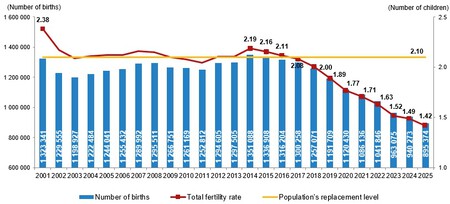
In Türkiye, 2025 was marked as the “Year of the Family”. The upcoming decade (2026-2035) has been designated as the era of “Family and Population”. This strategic focus underscores a growing concern within the Turkish government regarding declining birth rates, reminiscent of trends seen across numerous countries in Europe, Asia, and America. Notably, two pieces of data have sparked alarm within President Recep Tayyip Erdoğan’s administration: the number of births has been steadily declining since 2014, resulting in a fertility rate that has plummeted to the lowest level this century, straying far from the threshold necessary to maintain a stable population.
Despite the initiatives associated with the “Year of the Family,” Erdoğan’s measures have not yielded the intended effects. The issue reflects a deeper demographic winter, akin to those faced by countries like Japan, South Korea, and much of Europe. The ultimate concern is not just the falling birthrate; it is also the increasing skepticism within Turkish institutions regarding its potential solutions. Erdoğan’s frequent public exhortations to increase procreation highlight the urgency of the situation.
In March, the Minister of Family and Social Services, Mahinur Ozdemir Goktas, articulated this sentiment during an interview, stating that demography constitutes “a question of survival.” This dramatic framing indicates a broader recognition of how rapidly Türkiye’s birthrate decline mirrors trends that took decades to unfold in other nations.
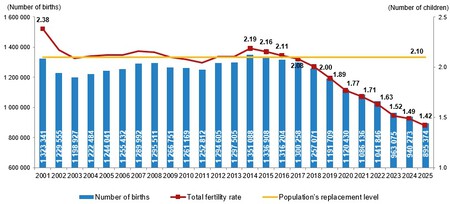
Number of births and total fertility rate, 2001-2025.
Recent statistics published by the Turkish Statistical Institute (TUIK) reveal an unflattering scenario for 2025: 895,374 babies were born, marking a 4.78% decrease from 2024, the lowest figure recorded since 2001. This decline further exacerbates the troubles with total fertility rates, which have lagged significantly behind necessary levels for years.
Understanding Critical Data
The ‘total fertility rate’ is a crucial indicator that concerns Ankara the most. It represents the average number of children a woman is expected to have throughout her reproductive years. In 2001, this figure was 2.38 births—well above the replacement rate of 2.1. However, since 2014, this number has continuously declined, decreasing to 1.77 in 2020, 1.49 in 2024, and hitting 1.42 last year. This marks the ninth consecutive year that Türkiye has fallen below the replacement rate, necessitating foreign immigration to maintain population levels.
Geographic Disparities in Birth Rates
The recent TUIK report indicates that, as of 2025, 76 provinces now exhibit fertility rates insufficient to sustain a stable population—an alarming increase from 57 in 2017. If mapped according to fertility ranges, Türkiye is predominantly marked in red, with only a few areas like Konya and some southern provinces managing to rise above a rate of 2.1 births per woman.
Social Trends and Economic Factors
Compounding the issue, Turkish women are not only having fewer children but are also waiting longer to start families. Recent data shows the average age of mothers has risen sharply from 26.7 in 2001 to 29.4 in 2025. Some provinces, such as Artvin and Istanbul, report even higher average ages for first-time mothers, nearing 30.
While Türkiye’s fertility rate remains above the EU average of 1.34, it reflects a worrying trend that has governmental officials treating demography as a state matter. Erdoğan has publicly labeled declining birth rates as a “disaster” and a “betrayal” against fertility control.
Government Initiatives and Public Opinion
In response, the government has implemented various pro-birth measures. Recently, Parliament extended maternity leave from eight to 16 weeks. Financial aids were also introduced, including a one-time payment of 5,000 liras for the first child, with additional monthly support for subsequent children.
However, public opinion reveals skepticism. Many parents cite rising living costs as a major deterrent against having more children. With high inflation rates eroding the value of government subsidies, many families find such financial support inadequate.
A recent report indicated that women with higher education levels tend to have lower fertility rates, with figures suggesting a stark correlation between educational attainment and childbearing patterns.
In summary, despite Türkiye’s enthusiastic policy initiatives aimed at boosting birth rates, the challenges remain formidable. The complexities of societal change, economic pressures, and evolving family structures suggest that merely increasing financial incentives may not suffice in reversing the trend.