
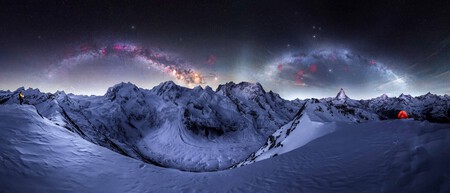
Capturing the Impossible: Angel Fux’s Alpine Adventure
“There are experiences that you plan for months and yet they arrive without you being prepared.” This quote from photographer Angel Fux embodies the essence of his latest endeavor, where he ventured to capture an extraordinary celestial event at an altitude of 4,200 meters in the Alps. Battling temperatures as low as -28ºC, fierce winds, and perilous icy ledges, Fux emerged with one of the year’s most stunning images, even drawing attention from NASA.
The Art of Astrophotography
Angel Fux, whose background is steeped in astrophotography and night landscape portraits, has traveled to some of the world’s most breathtaking locations, including the Alps and Andes. His passion for dark skies and capturing the ephemeral has only intensified over time. Recent trips to places like the Peruvian Andes inspired him to push boundaries and seek new vistas. This time, he targeted the Dent d’Hérens, situated just behind the iconic Matterhorn.
The Double Arc of the Milky Way
Fux didn’t just want to photograph a night sky; he aimed to capture the double arc of the Milky Way—a rare sight that occurs only for a few nights each March in the northern hemisphere. This phenomenon features both the winter and summer arms of the Milky Way appearing simultaneously above the horizon, a spectacle worth the arduous trek.
Aiming Higher: The New Challenge
The challenge was monumental. Not only was the ascension to the Dent d’Hérens over 1,000 meters higher than Fux’s previous adventure at Gornergrat in 2025, but the conditions were daunting. Few photographers dare to venture to such extremes during winter, particularly at night when the risks are amplified. To tackle this challenge, Fux enlisted professional mountain guide Richard Lehner and his son Arnaud to assist with logistics and safety.
The Preparation: Months of Planning
Fux invested six months preparing for this expedition. From meticulous planning logistics to rigorous equipment checks, every detail mattered. His gear included specialized clothing and a sleeping bag designed for extreme cold, alongside mountaineering essentials such as ice axes and ropes. The endeavor demanded not just physical endurance but also mental fortitude in the face of unpredictable elements.
Unexpected Challenges Along the Journey
Despite his thorough preparation, Fux faced several hurdles. During altitude acclimatization, his camera unexpectedly malfunctioned in the harsh cold, highlighting the technical difficulties inherent in astrophotography. Moreover, on the night of his planned shoot, temperatures plummeted to unforeseen lows, challenging their ability to work effectively.
A Surprise Outcome: The Triple Arc
As the night unfolded, Fux successfully captured the winter arc and then transitioned to the summer arc. However, when reviewing his shots, he discovered an unexpected phenomenon: the Gegenschein, a faint glow in the night sky, typically elusive in photographs. This breathtaking surprise elevated his planned double arc into a triple arc, combining all three components into one mesmerizing image.
The Final Touch: Post-Processing and Recognition
After descending from the mountain, the real test began—editing over 40 hours of footage, a painstaking process requiring immense patience and expertise. The final product—a stunning nightscape with three arcs—wowed both Fux and his family, who were eager to obtain large-format prints. This incredible image got the ultimate validation when NASA featured it among its selected astronomical images.
Capturing astronomical events like the double and triple arcs of the Milky Way requires not only masterful skill but also daring and resilience. Fux’s groundbreaking work serves as an inspiring testament to the art of astrophotography and the wonders of our universe.