
Cursor’s Composer 2.5: A Game-Changer in Programming AI
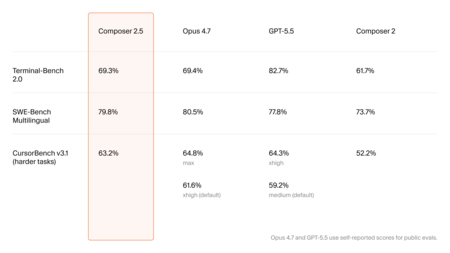
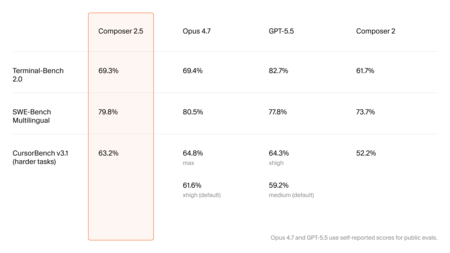
Cursor has officially launched Composer 2.5, a next-generation generative AI model designed exclusively for programming. What sets it apart? According to the startup, Composer 2.5 matches the performance of top models like Claude Opus 4.7 and GPT 5.5 but at a significantly lower cost. This powerful model is grounded in a Chinese AI framework, marking an interesting new player in the competitive AI landscape.
Specialization Over Generalization
While giants like OpenAI and Anthropic chase the ideal of general-purpose AI models, Cursor has taken a different approach. By developing an AI model focused solely on programming tasks, Cursor argues that extensive parameters—which often complicate other models—are not necessary to achieve excellence. This specialization allows for enhanced efficiency and cost-effectiveness, akin to a sprinting specialist outperforming a decathlete in the 200-meter dash.
Performance Analysis
Cursor’s claims about Composer 2.5 are backed by tests against established benchmarks. The model reportedly delivers programming performance equivalent to that of GPT-5.5 and Claude Opus 4.7, which are considered top-tier in the industry. Nevertheless, the real game-changer lies in its cost-efficiency.
Cost Comparisons
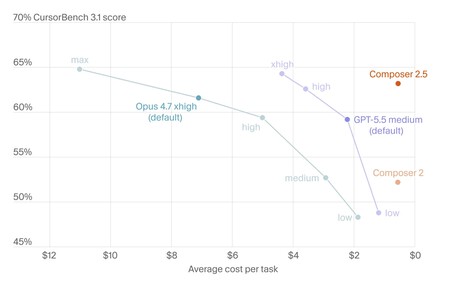
Understanding costs in AI model usage is crucial for businesses. The results from the CursorBench 3.1 benchmark are particularly enlightening: Composer 2.5 solved 65% of tasks for only $0.30 per request. In contrast, achieving the same success rate with GPT-5.5 costs approximately $4, while Claude Opus 4.7 escalates to about $11. The accompanying API pricing also clearly demonstrates the impressive savings: only $0.5 per million input tokens and $2.5 per million output tokens.
Innovative Training Methods
Composer 2.5 employs a unique reinforcement learning approach, enabling it to offer real-time feedback and corrections throughout the programming process. Instead of merely evaluating end results, the model fine-tunes its outputs as it works, engaging in a two-way learning process. Remarkably, 85% of the training budget focused on reinforcement learning, reinforcing its capabilities in code refactoring and bug fixing.
A Global Perspective
Cursory insights reveal that Composer 2.5 is built upon the AI models from the Chinese startup Moonshot, specifically derived from Kimi K2.5. This foundation has allowed Cursor to significantly enhance its model’s performance across various programming metrics, making impressive strides in fields like agentic behavior evaluation.
The Future Ahead
Cursor has evolved from being a niche AI company into a strong contender in the tech landscape, especially for organizations looking for efficient programming solutions. This competitive edge is underscored by renowned figures like Elon Musk expressing interest in acquiring the company, with reports indicating an agreement for a potential $60 billion purchase. This creates a golden opportunity for both parties, leveraging Colossus’ infrastructure to expand into the lucrative enterprise sector.
In conclusion, as AI models like Cursor’s Composer 2.5 rise, the programming landscape is poised for significant change. With its focus on specialization, affordability, and innovative training methods, the race for the best programming AI model has never been more thrilling.