
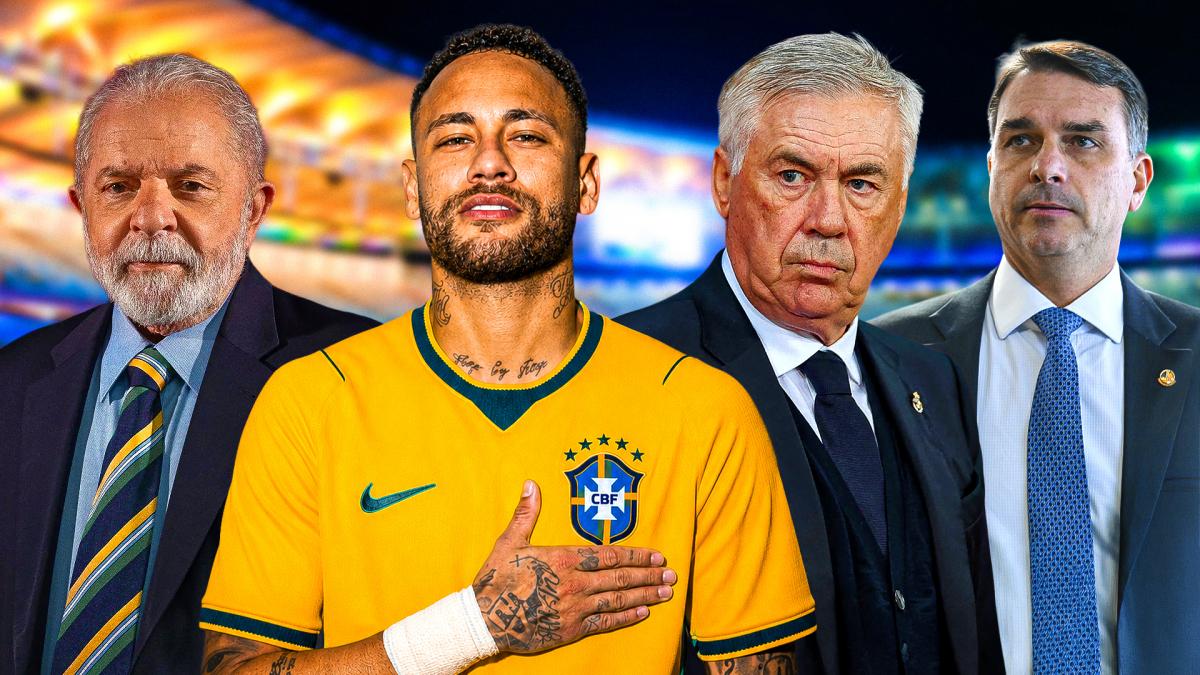
The Political Game Behind Carlo Ancelotti’s Call-Up for Neymar
Carlo Ancelotti’s roster for the 2026 World Cup transcends the boundaries of a mere sporting event. In Brazil, every call-up, especially that of Neymar, reveals deeper cultural and political dynamics. Neymar’s return to the Seleção not only rekindles debates over his fitness and form but also speaks volumes about Brazil’s identity and the socio-political climate. The Seleção is not simply a football team; it is an emotional embodiment of Brazilian identity and historical narratives.
Contextualizing Neymar’s Return
As Brazil stands on the brink of a polarized election season, Ancelotti’s decision to call Neymar back stirs the pot further. The tension between Luiz Inácio Lula da Silva’s supporters and the remnants of Bolsonarism, particularly through figures like Flávio Bolsonaro, adds layers of complexity to Ancelotti’s task. Neymar, who openly supported Jair Bolsonaro in past elections, has become a contentious symbol—viewed by many as the embodiment of a nationalist, conservative Brazil.
The Role of Ancelotti: A Mediator in a Fractured Landscape
Ancelotti enters this arena not just as a football coach but almost as a neutral arbiter aiming to bridge a deeply fragmented society. His reputation as an apolitical figure might allow him some distance from local narratives, but the very act of selecting Neymar propels him into the eye of a storm. In a social landscape where every Seleção decision is scrutinized, the Italian coach finds himself facing the challenge of reintegrating a player who stirs strong feelings on both sides of the political divide.
Football as Symbolic Territory
The complexities of football in Brazil stretch back to the military dictatorship era, where the national team served as a tool of propaganda. The legendary 1970 World Cup team became a symbol of national unity amidst repression, further entrenched by football’s capacity to provide a narrative for the nation. This historical backdrop raises questions about Neymar’s role today—are we witnessing the transformation of a mere footballer into a political icon, as each match becomes a canvas upon which the country’s cultural and political narratives are painted?
Neymar’s Dichotomy: National Icon or Political Symbol?
Neymar stands at a cultural crossroads. His support for Bolsonaro has associated him with conservative values, leading a significant portion of the population to view him as a divisive figure. Amidst this, Lula’s administration seeks to reclaim the Seleção from what some perceive as a political hijacking by the right. Lula’s past comments, suggesting that players should earn their places based on merit rather than celebrity, signal a reparation of the narrative surrounding football.
The Road Ahead: A Politicized World Cup
As the 2026 World Cup approaches, it is poised to be one of the most politicized global sporting events. The tournament, primarily hosted by the U.S., coincides with the political re-emergence of figures like Donald Trump, further embedding football within the larger geopolitical theater.
In this murky landscape, Ancelotti must navigate not just a team but the weighty expectations of a nation. The Seleção is more than just a football team; it embodies Brazil’s social fabric, political ambitions, and cultural dilemmas. Each appearance by Neymar in the yellow jersey is not only a sporting gesture but also a political statement, further complicating Ancelotti’s already daunting task.
In the end, the football pitch in Brazil extends well beyond the game; it becomes a battleground for social identities, political aspirations, and national narratives. As the 2026 World Cup looms on the horizon, it remains to be seen how Ancelotti will manage to keep the Seleção unified and competitive amidst the surrounding turmoil.