
UPTA Proposes Minimum Contribution for Mutual Members to Join RETA
The Union of Professionals and Self-Employed Workers (UPTA) in Spain has recently put forth a significant proposal aimed at facilitating the transition of members from mutual societies to the Special Regime for Self-Employed Workers (RETA). This initiative seeks to ensure a balance within the public pension system while enhancing the retirement options for mutual members.
Key Aspects of the Proposal
UPTA emphasizes that any transition bridge between mutual societies and RETA should prioritize “contributory justice,” financial sustainability, and equitable treatment of the many self-employed individuals who have consistently contributed to the public system over the years.
Minimum Contribution Requirement
To join the RETA while retaining retirement rights, UPTA proposes that mutual members must demonstrate a minimum annual contribution of €2,716.56. This value is derived from the current minimum monthly payment for self-employed workers—approximately €294—adjusted using a coefficient of 0.77. Consequently, the monthly contribution required would amount to €226.38. Over a 37-year professional career, this would lead to a cumulative contribution exceeding €100,500, thereby aligning the efforts of mutual members with those necessary to access 100% of the public retirement pension.
Ensuring Fairness and Equity
UPTA insists that this proposed amount serves as a minimum economic benchmark for mutual members wishing to transition to RETA. The organization’s objective is to prevent any grievances among those who have long supported the public social protection system through their contributions.
Additional Provisions for Top Contributors
For mutualists whose accumulated funds exceed the minimum contribution, UPTA proposes that the surplus could be voluntarily transferred to enhance their future retirement regulatory base within the public system. However, they caution that this additional recognition should not exceed double the minimum contributory pension, thereby maintaining a proportional relationship between contributions made and prospective benefits.
Rising Demand for Integration into RETA
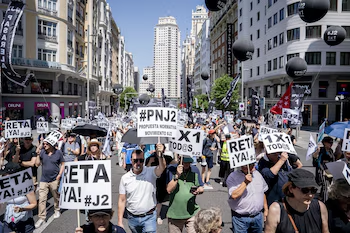
The UPTA’s proposal comes in response to growing discontent among professionals linked to alternative mutual systems. Many are looking for pathways to move into the public pension system due to perceived inadequacies in their current coverage.
Eduardo Abad, the president of UPTA Spain, maintains a clear stance: mutual professionals seeking to transition should be able to contribute to RETA under the same conditions as their self-employed counterparts. He acknowledges that numerous mutual members are eager to shift from their current pension schemes to the public system.
Institutional Consensus and Sustainability
UPTA underscores that any reforms must emerge from institutional consensus and ensure legal security. The organization stresses that care must be taken to avoid jeopardizing the financial sustainability of the public system or creating inequities between those who have contributed to RETA their entire careers.
Closing Thoughts
The dialogue surrounding the future of alternative mutual societies remains a vital issue for self-employed professionals. As thousands advocate for integration into the public system, UPTA and similar organizations are determined to ensure that any transitions promote equal treatment and stability across the pension landscape. By establishing clear contribution requirements, UPTA aims to foster an equitable environment for all self-employed individuals in Spain.