
The AI Duopoly: OpenAI and Anthropic Dominate the Market
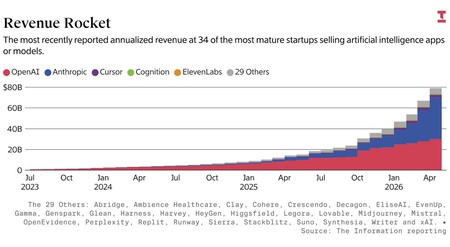
Everyone wants a slice of the booming AI ecosystem, but the reality reveals a stark truth: the majority of profits are concentrated in the hands of two players—OpenAI and Anthropic. An analysis from The Information highlights how these companies capture a staggering 89% of the revenue generated by the 34 most relevant companies in the generative AI sector.
Staggering Growth in Revenue
The overall AI industry is experiencing phenomenal growth, with an annualized income of $80 billion, translating to approximately $6.6 billion each month. This remarkable figure marks a 112% increase from just six months prior, showcasing the sector’s breakneck speed of growth.
Who Really Wins?
While the industry figures are promising, the overwhelming concentration of profits raises questions. Out of the $80 billion, nearly 89% is cornered by OpenAI and Anthropic, leaving just 11% for the remaining 32 companies. This imbalance illustrates the competitive landscape of the AI market, where major players retain the lion’s share of profits while others scrap for the remainder.
What’s Included in the Generative AI Sector?
The report from The Information focuses specifically on generative AI companies, excluding larger hyperscalers like Amazon, Microsoft, and Google, which, while significant players in tech, have diversified portfolios beyond generative AI. This distinction emphasizes the rapid earnings growth among the selected 34 firms.
Revenue Sharing Agreements
OpenAI and Anthropic’s impressive revenue figures come with caveats. Anthropic must share some of its revenues with tech giants like Amazon and Google, which resell their services. Additionally, OpenAI commits 20% of its revenue to Microsoft until 2030, which translates to an estimated $6 billion this year alone. Such revenue-sharing agreements complicate their financial narratives, showing that their earnings aren’t entirely their own.
Continued Spending vs. Profitability
Even with booming revenues, both companies face daunting financial realities. OpenAI anticipates a staggering $600 billion in computing expenses by 2030, with losses expected to triple in 2026, potentially reaching $14 billion. While revenue streams look promising, the accompanying expenditures paint a less rosy picture.
Conversely, Anthropic’s cash flow projections suggest a slowdown in losses with expectations of reaching $17 billion in cash flow by 2028. However, this remains an estimate and is not a surefire prediction of profitability.
Emerging Competitors
Despite OpenAI and Anthropic’s dominance, several startups are making headway, with three notable companies—Perplexity, ElevenLabs, and Cognition—each surpassing $500 million in annual revenues. Their success indicates that while the giants of the industry are well-established, new contenders are beginning to carve out their niches.
The Growing Gap
Although these startups are achieving significant milestones, they still operate on a much smaller scale compared to OpenAI and Anthropic. The two giants continue to lead the pack, with Anthropic recently eclipsing OpenAI in market valuation due to its burgeoning services, including the highly successful Claude model.
IPO Prospects
Both companies are gearing up for potential initial public offerings (IPOs), each aiming to draw in approximately $60 billion from investors. Should these IPOs succeed, they could achieve market capitalizations reaching nearly a trillion dollars, a benchmark currently only met by a handful of companies globally.
In a rapidly evolving tech landscape, the story of OpenAI and Anthropic serves as both an inspiration and a cautionary tale, illustrating the challenges and opportunities that lie in the quest for AI dominance.