
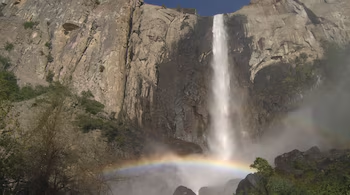
Discovering Moonbows in Yosemite
Yosemite National Park transforms into a celestial wonderland during spring and summer, revealing a rare phenomenon known as moonbows. These lunar arches are a nocturnal optical marvel that few have the chance to witness, making Yosemite one of the most reliable locations for such an experience worldwide.
What are Moonbows?
Moonbows occur when the light from a full moon interacts with water droplets, typically from Yosemite’s iconic waterfalls. The resulting arc often appears silvery to the naked eye, but digital cameras can capture vibrant colors similar to those seen in a daytime rainbow. This enchanting display of nature is made possible through a combination of environmental conditions prevalent in Yosemite.
Optimal Conditions for Viewing Moonbows
For a moonbow to be visible, several specific conditions must be met:
- Full or Almost Full Moon: The light from the moon needs to be at its peak.
- Clear Skies: A cloudless sky around the moon helps enhance visibility.
- Intense Water Mist: The waterfalls must produce enough fog to refract the moonlight.
- Total Darkness: The sun should be well below the horizon, allowing complete nighttime conditions.
- Correct Moon Position: The alignment of the moon must be free from obstructions, ensuring that its light is unobstructed.
Timing Your Visit
The peak season for observing moonbows coincides with the lunar cycle from spring until mid-summer. For those interested in planning ahead, the last opportunity to witness this phenomenon in 2026 will be between May 28 and June 3, particularly due to a drier winter resulting in earlier thaws.
Historical Context and Scientific Predictions
The scientific intrigue surrounding moonbows can be traced back to the 19th century when naturalist John Muir first documented these mesmerizing phenomena associated with Yosemite Falls. His accounts laid the groundwork for modern astronomical models developed to predict moonbow occurrences more accurately. Experts like Donald Olson from Texas State University, and more recently Brian Hawkins, have made significant advancements in forecasting when moonbows are likely to appear, providing enthusiasts and photographers with invaluable information.
Preparing for the Experience
Photographers and nature enthusiasts converge at Yosemite to capture the ethereal beauty of moonbows. It requires patience, often involving hours waiting in the dampness of night while navigating slippery terrain. Therefore, it’s crucial to come prepared with shoes that provide good traction and expect to get wet from the mist created by the waterfalls.
Accessing Yosemite
For those wishing to see a moonbow firsthand, Yosemite is easily accessible from several airports. The most straightforward route is from Fresno Airport, located about two and a half hours away by car. Other nearby airports include those in San Francisco, Oakland, San Jose, and Sacramento.
Conclusion
Observing moonbows in Yosemite offers a unique experience that blends natural beauty with scientific wonder. The combination of ideal conditions, meticulous planning, and a little bit of luck can result in witnessing one of nature’s rarest optical spectacles—an ethereal lunar arc illuminating the night sky, a memory that will last a lifetime.