
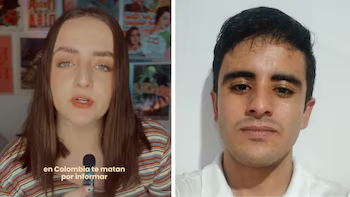
The shocking discovery of Mateo Pérez Rueda’s body, a 26-year-old journalist who went missing in Briceño, Antioquia, has reignited conversations about the perilous state of journalism in Colombia. This incident has stirred further reflection from historian Juliana Bernal, known as ‘Historia de melocotón’ online.
The Historical Context of Journalism in Colombia
In her recent analysis, Bernal poses a poignant question: “Why has journalism been murdered in Colombia for more than half a century?” She traces a timeline filled with decades of violence, censorship, and the tragic murders of journalists, exposing a painful reality.
“Colombia is a country where practicing journalism is an act of bravery and, many times, a death sentence,” Bernal remarks in her presentation. Since the mid-20th century, numerous journalists have faced threats and attacks while reporting on corruption, armed conflicts, and drug trafficking.
The Perpetrators
Violence against journalists in Colombia isn’t confined to one era or group. During the 80s and 90s, drug cartels and armed groups were predominant threats. Today, dissidents, paramilitary factions, and local mafias continue to target those who dare to tell the truth.
Bernal emphasizes that Mateo Pérez’s murder is not an isolated incident but rather part of a long tradition of violence against journalists. “Mateo is the latest on a list that already includes more than 170 journalists murdered since 1977,” she states. “His death is emblematic of a country where information can be lethal.”
Regional Journalists at Risk
Regional journalists like Pérez often find themselves in the crosshairs due to their proximity to local issues. They are the frontline reporters who reveal the stark realities of villages and municipalities where state presence is minimal. “They are the ones who know the stories that need to be told, making them vulnerable to threats and attacks,” Bernal notes.
The Cycle of Impunity
The enduring violence against journalists stems from a continuously unsolved murder rate, which fosters a culture of fear. “Despite multiple alerts and protection schemes, a majority of murders remain unresolved, allowing perpetrators to act with impunity,” Bernal observes. This sends a distressing message that those who kill journalists are unlikely to face consequences.
Stigmatization and Silence
Stigmatization is another significant factor affecting journalists in Colombia. They are often labeled as enemies of the state or guerrilla sympathizers, which creates a hostile environment. “When the government marginalizes journalists, it legitimizes violence against them,” Bernal warns. This hostile backdrop leaves journalists vulnerable and unsupported.
Remembering the Fallen
Bernal calls for an urgent reminder: “Every murdered journalist is a wound in democracy and a loss in collective memory. It’s essential to grasp that every silence imposed by violence is one less truth for society.” This statement underscores the critical importance of remembering those who have paid the ultimate price in pursuit of truth and justice.