
Understanding Olfactory Mapping: A Breakthrough in Smell Science
The Complexity of Smell
For decades, science has successfully mapped our primary senses—sight, hearing, and touch—each tracing a clear path from sensory organs to the brain. However, the intricate world of smell remained elusive, primarily due to its complexity. The mammalian olfactory system, particularly that of mice, includes over 20 million neurons and more than a thousand different receptor types. This biological chaos has made it challenging to understand how smells are detected and processed.
Revolutionary Findings from Harvard Research
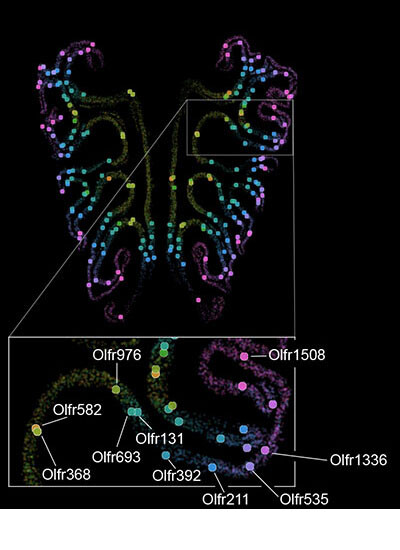
A groundbreaking study led by a team from Harvard University has finally illuminated the mysteries of the olfactory system. Researchers discovered that olfactory neurons are not randomly arranged in the nasal cavity but are organized in a spatial map based on overlapping stripes. This unique arrangement is consistent across various animal species, indicating a conserved biological architecture.
Mirror of the Brain’s Olfactory Map
One of the study’s most remarkable findings is that this banding structure corresponds directly to the organization of the olfactory bulb in the brain. Essentially, the location of a neuron in the nose dictates precisely where its signal is sent in the brain, allowing for the localized interpretation of different odors. This topographic continuity reinforces the idea that the brain relies on the geographic positioning of neurons for smell identification.
Importance of Olfactory Mapping
Understanding this mapping holds crucial implications for several fields, particularly neuroplasticity and the regeneration of the sense of smell. Currently, the loss of this vital sense often remains untreated, primarily due to a lack of understanding of the underlying system architecture. The COVID-19 pandemic highlighted this issue, demonstrating how viral infections can disrupt olfactory pathways. By comprehending the olfactory system’s original design, researchers can develop targeted treatments that address the root cause rather than merely reacting to symptoms.
Contextualizing the Findings
Mammalian olfaction is notably complex, especially given that a mouse contains approximately 20 million olfactory neurons—all uniquely expressing various receptor types. In comparison, human color vision relies on only three types of photoreceptors. Thus, the intricate nature of the olfactory system has historically led scientists to mistakenly view receptor distributions as random.
Although Linda Buck and Richard Axel received the Nobel Prize in 2004 for their work on olfactory receptors, they did not explain the organizational structure of these receptors. Today’s advancements in molecular biology, especially through techniques like spatial transcriptomics, now allow for in-depth analysis of individual cells in their original locations.
Methodology of the Study
The Harvard team meticulously analyzed around 5.5 million neurons from more than 300 mice. They employed two crucial techniques: single-cell sequencing, which reveals the receptors expressed by individual neurons, and spatial transcriptomics, providing precise locations of these neurons within the tissue.
They identified retinoic acid as the key molecule responsible for the creation of this spatial map. By manipulating chemical gradients of retinoic acid during embryonic development, researchers observed shifts in receptor stripes, confirming its role as a molecular GPS.
Limitations and Future Challenges
Despite these promising findings, the study’s limitations are significant. The research was conducted in mice, leaving uncertainty about whether similar organization exists in humans. While the basic structure of the olfactory system is conserved across mammals, humans feature significantly fewer functional receptors—approximately 350 compared to over 1,000 in mice.
Moreover, answers still elude researchers regarding the specific reasons behind this receptor organization. It remains unclear whether the stripes are grouped by the chemical structure of odors or their biological significance, such as differentiating between the smells of food and danger. Unraveling this logic will be a substantial undertaking for future research.
Conclusion
The Harvard research team has set the stage for a deeper understanding of the olfactory system, paving the way for better treatments and greater insights into smell. As science continues to demystify the human experience of odor, it may unlock new avenues for addressing the challenges of anosmia and enhancing our sensory interactions with the world.