
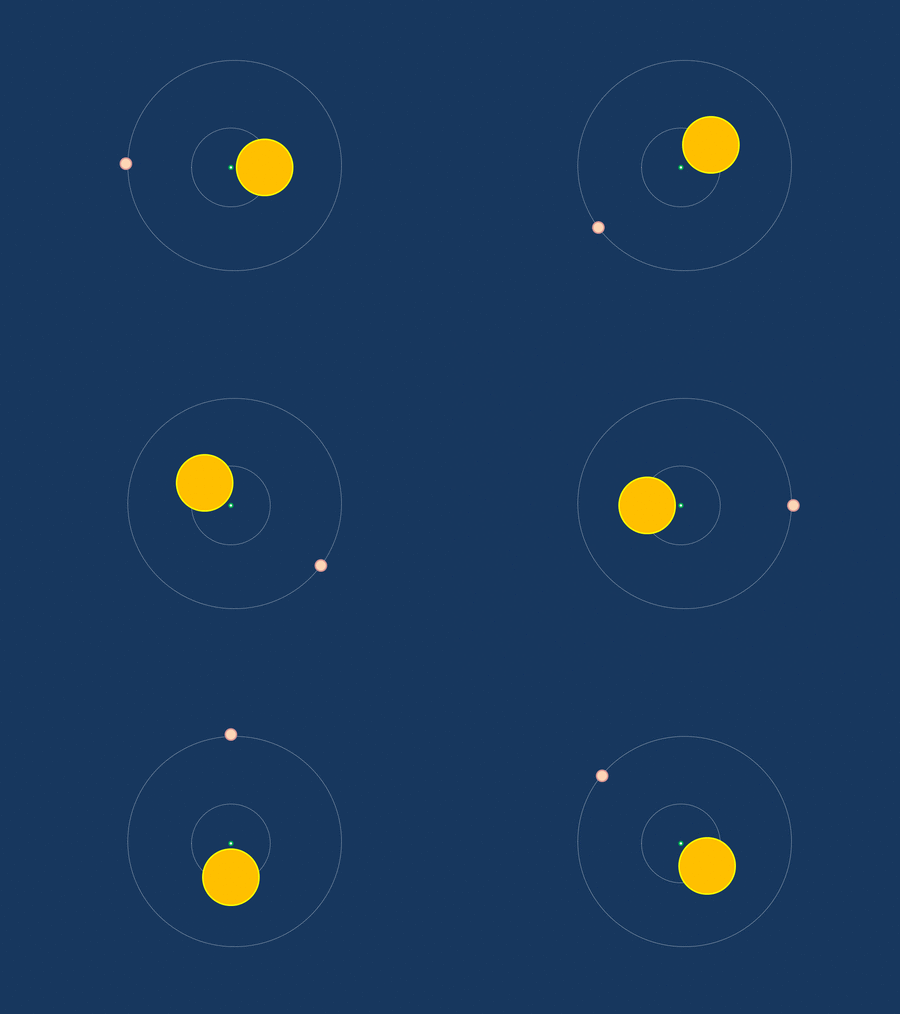
Unveiling the Truth: Jupiter’s Orbit and the Barycenter Concept
If you are over 30 years old, you probably learned in school that there are nine planets that revolve around the Sun. Then you found out that there were only eight, as Pluto lost its classification as a planet and became a dwarf planet. Adding to this cosmic shift is the revelation that Jupiter, the largest planet in our Solar System, does not solely revolve around the Sun. Sometimes, neither does Earth! It’s time to unpack this simplification we were taught.
Understanding the Barycenter
It is not the center, but the barycenter. Gravitational force poses intriguing dynamics in the cosmos. While we often hear about the Sun’s immense pull on Earth, it’s essential to note that all planets exert a gravitational influence on the Sun as well. This interaction implies that the actual center around which the planets, including Jupiter, rotate isn’t precisely at the Sun’s core; instead, it is slightly offset, located at a point known as the barycenter.
To grasp this better, consider that every object has a center of mass, a theoretical point where its mass is concentrated for practical calculations. For instance, if you try to balance a ruler on your finger, the best position is directly beneath the ruler’s center. In the Solar System, this barycenter is very close to the Sun, accommodating 99.86% of the total mass of the system, but it can be influenced by the gravitational pull from other celestial bodies.
Jupiter’s Role in the Solar System
The case of Jupiter. With the Sun holding such a major chunk of the Solar System’s mass, Jupiter captures a significant portion of the remaining mass—around 70%. This makes it the most significant influencer on the barycenter, pulling it outside the solar surface. Consequently, Jupiter doesn’t revolve strictly around the Sun, but rather orbits a point that exists even beyond the Sun itself.
Earth and Moon Dynamics
The case of the Earth and the Moon. Similar to Jupiter, the Earth does not revolve solely around its center. The Earth and Moon have their own barycenter, which is located approximately 5,000 kilometers from Earth’s center. While this barycenter is still within our planet, it is not exactly centered, indicating that the Moon does have a significant influence on Earth’s orbital path.
Shifting Dynamics in the Solar System
The Earth does revolve around the Sun…sometimes. When considering the gravitational influences of other planets, particularly the gas giants, the barycenter shifts. In an isolated Sun-Earth scenario, the center of gravity would lie almost in the center of the Sun. However, the presence of Jupiter, Saturn, Uranus, and Neptune, the “sailors” of our Solar System, alters this equilibrium. When they align, the effects can be substantial enough to pull the barycenter outward, sometimes displacing Earth’s orbit around the Sun.
In short, the planets do not revolve around the Sun in a simplistic manner as we were once taught. The influence of gravitational forces leads to a more complex dance of celestial bodies. While our educational systems aim to simplify these concepts, it can feel like a form of deception. Understanding the intricacies of orbital mechanics not only broadens our knowledge of astronomy but also highlights the beauty of our cosmic dance.
Image | NASA | Martin Jediny (Wikimedia Commons)