
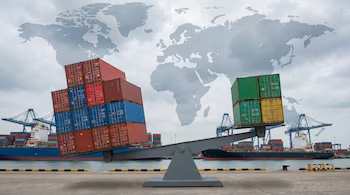
El Salvador’s Trade Deficit: Analyzing the 7.9% Increase in Q1 2026
The Salvadoran economy entered 2026 with notable challenges, as indicated by the recent data released by the Central Reserve Bank (BCR). The trade balance deficit for the first quarter has reached an alarming $2,769.8 million, marking an increase of 7.92% compared to the previous year’s figures. This increase reflects an additional $203.2 million in negative balance, raising questions about the country’s economic health and future strategies.
Understanding the Trade Balance
To better comprehend these statistics, it’s crucial to clarify the concept of the trade balance. In simple terms, it’s the record of goods a country sells abroad (exports) versus those it buys from other nations (imports):
- Surplus: When a country sells more than it buys (profits).
- Deficit: When imports exceed exports (losses).
For El Salvador, the disparity is significant. During the first quarter, the country exported $1,663.4 million worth of goods while importing $4,433.2 million. This substantial gap – the deficit – urges immediate attention.
Economic Dependency
The increase in the trade deficit suggests a growing dependence on foreign products. While exports grew by 6.3%, indicating a more active local industry, imports also surged by 3.6%. This means that, despite progress in exports, the overwhelming volume of imports continues to dominate the trade balance.
Moreover, while the term “deficit” might evoke immediate concern, it does not necessarily indicate an impending crisis. However, it does highlight the country’s reliance on external production and necessitates alternative sources of foreign currency, such as remittances or loans, to cover the deficit.
Key Imports and Exports
A closer look at El Salvador’s import and export landscape reveals critical sectors. Notably, essential goods that the country cannot produce in adequate quantities contribute substantially to the import expenses:
- Petroleum Oils: Accounting for $436.6 million, energy remains a significant economic burden.
- Medications: Investments of $184 million help supply both the health system and private pharmacies.
Conversely, the textile sector provides a bright spot in the export domain, showcasing the following contributions:
- Shirts: Generated $112.9 million in revenue.
- Sweaters: Contributed $98.8 million.
- Transport Items: Added $80 million.
The USA: A Double-Edged Sword
The trade relationship with the United States is a critical component of El Salvador’s economic framework. The U.S. remains the primary client and supplier. In the first quarter, El Salvador imported goods worth $1,119.6 million but managed to export only $563.7 million. This imbalance underscores the heavy reliance on U.S. products and the need for strategic maneuvers to enhance local production capabilities.
Conclusion
In summary, El Salvador faces considerable economic hurdles with its increasing trade deficit. While there are positive trends in export growth, the over-reliance on imports poses serious challenges. The government must explore innovative strategies to strengthen local industries and diversify trade relationships. Addressing these issues is essential for ensuring a more stable economic future and reducing dependency on foreign markets.