
Global Military Spending Trends in 2025
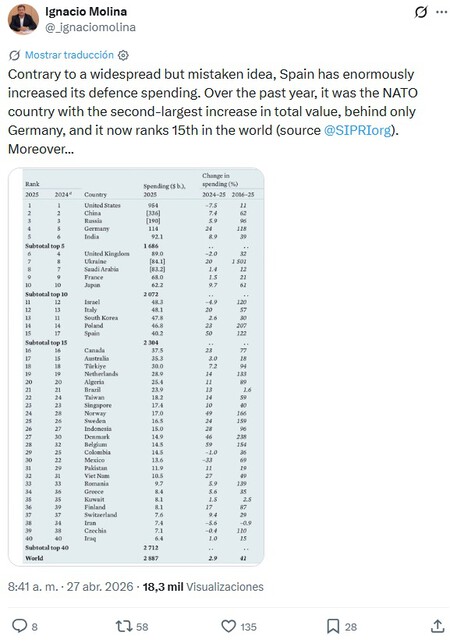
With global tensions rising due to continued conflicts such as the Ukraine invasion and geopolitical strategies shifting, nations worldwide have decided to significantly ramp up military expenditures. According to the Stockholm International Peace Research Institute (SIPRI), global military spending surged by 2.9% in 2025, reaching an alarming $2.9 trillion. Amidst this trend, one country stands out: Spain.
Spain’s Unforeseen Military Investment Surge
Despite its ongoing challenges with NATO leadership and friction with the U.S., Spain has emerged as a key player in military spending, ranking among the top 15 nations globally. Spain’s defense budget now exceeds €34.256 billion, showcasing a generous 50% increase from the previous year and an astounding 122% surge since 2016. Significantly, this marks the first time since the 1990s that Spain’s military spending has surpassed 2% of its GDP.
Factors Driving Spain’s Investment
Spain’s notable investment is attributed primarily to the Industrial and Technological Plan for Security and Defense, which aims for an initial investment of €10.471 billion by 2025. This robust strategy is an essential aspect of Spain’s military strengthening efforts, leading to a swift rise in defense allocations compared to other European countries.
Comparison with Other Nations
While the U.S., China, and Russia dominate global military spending in terms of volume, Spain’s recent spending increase outpaces other countries such as Belgium, which recorded a 59% rise but operates on a significantly lower budget of around $14.5 billion. Spain’s ability to secure its place in the global “TOP 15” for military investment is a striking development, especially when compared to traditional European powers.
Implications of Increased Military Spending
Spain’s escalating military budget has implications beyond financial numbers. The increase reflects not just a response to external pressures, particularly from the U.S. and NATO, but also domestic recognition of the need for enhanced defense capabilities. Despite Spanish officials claiming to meet NATO commitments at 2.1% of GDP—amid tensions over the proposed increase to 5%—the country has managed to forge its own path, emphasizing its dedication to stepping up defense efforts.
Global Context: Who Else is Spending?
Broadly, military expenditures globally have continued to rise, with Europe’s spending increasing by 14%, in stark contrast to a 7.5% decline in the U.S. It’s important to note the disparity in how this additional spending is allocated. Major increases are noted in Russia (5.9%), Ukraine (20%), China (7.4%), and Japan (9.7%), showing varied geopolitical responses to existing threats.
Why This Matters
The increase in military spending signifies a broader shift toward militarization across nations, as fears of conflict and security concerns mount. These trends are likely to shape international relations, defense strategies, and global stability in the coming years.
Conclusion
As military budgets grow worldwide, Spain’s emergence as a leading spender remains surprising yet indicative of broader trends in national security policy. This trajectory raises questions about future diplomatic relations, defense capabilities, and the potential for increased tensions in a world marked by uncertainty.