
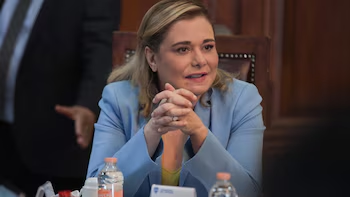
Maru Campos’ Decision: Declining Senate Invitation Amid CIA Investigation
The recent events surrounding the Central Intelligence Agency (CIA) and its clandestine operations in Mexico have triggered significant political discourse. Governor María Eugenia Campos Galván of Chihuahua has opted not to appear before the Senate regarding the investigation tied to the recent incident involving CIA officials. This controversial decision raises questions about both legal implications and national security.
Background of the Incident
Two CIA officials tragically died in a car accident in northern Mexico while participating in an undercover anti-drug operation. Notably, these officials lacked the accreditation to operate within Mexican territory; one held a diplomatic passport, while the other had entered the country as a tourist. Mexican law explicitly prohibits foreign agents from engaging in operations in the country, a rule seemingly violated by the Chihuahua government, which allegedly coordinated directly with the CIA without involving the Foreign Ministry.
Senate Invitation and Campos’ Response
In light of these serious developments, the Senate summoned Governor Campos to a meeting with the Commissions on Constitutional Points and Public Security. This invitation had been confirmed by legislators from both the National Action Party (PAN) and the MORENA party and was set for April 28. However, the scheduled meeting did not appear on the official Senate agenda, leading to speculations about the governor’s intentions.
On the eve of her expected appearance, Campos communicated her decision through a formal letter addressed to María Martina Kantún Can, the Secretary of the Board of Directors of the Senate. In her letter, she declined the invitation, citing concerns that her presence might compromise ongoing investigations. Campos articulated her commitment to safeguarding the investigation’s integrity, emphasizing the need to avoid jeopardizing confidential information that could impact national security.
Implications of Campos’ Decision
While Campos’ legal stance is defensible—since the Senate invitation was non-mandatory—her absence leaves critical questions unanswered. Specifically, the public is left wondering what precisely transpired in Chihuahua, who authorized the coordination with the CIA, and why such actions were undertaken without proper notification to the Foreign Ministry or adherence to the National Security Law.
Moreover, Campos referenced the establishment of a Specialized Unit for investigating activities linked to the dismantling of the “El Pinal” narco-laboratory in the municipality of Morelos. The state government has assured that this unit is actively collaborating with the Attorney General’s Office to proceed with the investigation.
Ongoing Investigations
The Federal Attorney General’s Office (FGR) has initiated investigations paralleling those of the state unit, but the Senate is currently left awaiting clarity. Campos’ avoidance of the Senate’s inquiry raises more questions than answers at a time when transparency is crucial for public trust and accountability.
Conclusion
Maru Campos’ decision to decline the Senate invitation continues to reverberate amidst an atmosphere of political scrutiny and public concern over national security issues. As investigations unfold, both state and federal authorities must navigate the complexities of this incident, ensuring that the principles of transparency and legality are upheld for the sake of public confidence and national integrity. The situation remains fluid, with ongoing developments expected to shed light on the unfolding narrative.