
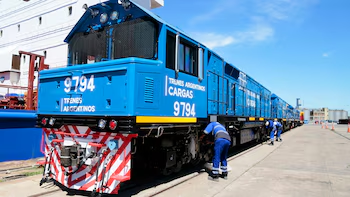
Funding Road Infrastructure through Belgrano Cargas Privatization
Privatization Process and Government Measures
The privatization of Belgrano Cargas y Logísticas SA is advancing through various measures implemented by the National Executive Branch. These measures seek to reshape the future of Argentina’s railway system. Following the publication of Decree 282/2026 in the Official Gazette, the government has decided the allocation of funds from rolling stock sales and has set guidelines for asset valuation.
Allocation of Proceeds for Road Infrastructure
According to the decree, proceeds from the sale will be deposited into a trust regulated by Decree No. 976/01. The trust’s primary aim is to finance and pay for road infrastructure projects that will be managed by private operators. The government mandates adherence to the minimum valuation set by the National Appraisal Court.
The fund allocation strategy incorporates the public auction of rolling stock and potential sales through national and international bidding processes concerning road concessions and complementary properties.
Bidding Process and Future Expectations
The decree further assigns the Secretary of Transportation from the Ministry of Economy the responsibility to specify not only the rolling stock included in bid proposals but also the conditions for the concession of lines such as General Belgrano, General San Martin, and General Urquiza.
As the privatization process nears completion, the government intends to publish the bid documents next month. The awarded company will control the freight train operations for the next 50 years.
Stakeholders in the Privatization
Among those interested in the concession is Grupo México, through its subsidiary Mexico Transport Group (GMXT). This company, owned by one of Mexico’s wealthiest individuals, manages an extensive railway network primarily focused on cargo transport via Ferromex and Ferrosur and the Florida East Coast (FEC) rail in the United States.
The existing national transport systems lag in efficiency compared to their international counterparts. For instance, U.S. and Mexican trains can travel around 600 kilometers in just nine hours, transporting larger cargo loads, whereas the Argentine trains take four days for similar routes, operating at lower speeds and capacities.
Future Investment and Open Access Model
Belgrano Cargas is crucial in transporting grain from NOA to the ports near Great Rosario. Although investments have been made recently, enhanced efficiency remains imperative.
In alignment with the successful Mexican model for railway privatization, which significantly improved standards post-1990s, Grupo México plans to invest USD 3 billion over five years in Argentina. The competition for concessions also includes a consortium of leading cereal companies, showing a robust interest in the agricultural corridors.
The government aims to finalize the transfer of operations to private entities by mid-year under an “open access” model. This will facilitate flexible operations while allowing multiple companies to manage railroad infrastructure, enhancing efficiency and service quality.
Conclusion
The privatization of Belgrano Cargas signifies a pivotal shift in how Argentina manages its railway and road infrastructure. With careful planning and investment, the government hopes to modernize transportation in the country and improve economic efficiency through strategic government-private partnerships.