
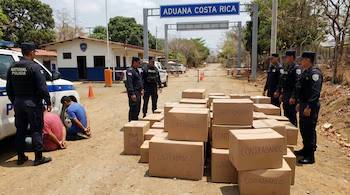
Costa Rican Justice Detects Sustained Growth in Smuggling and Links to Organized Crime
Scope of the Smuggling Crisis
Judicial investigations in Costa Rica have revealed alarming trends in merchandise smuggling, surpassing drug trafficking in its overall impact. As of March 2026, there are 293 active cases reported across prosecutorial and criminal justice systems. This phenomenon, which encompasses a range of products from liquor and cigarettes to counterfeit goods, is a significant concern for national security.
Economic Burden of Smuggling
Smuggling in Costa Rica is an illicit business estimated to be worth ₡1 billion annually (approximately $2.19 billion USD), accounting for 2.6% of the Gross Domestic Product (GDP). This illegal trade not only hampers tax revenue but also distorts competition by enabling the sale of goods at below-legal prices. Recent operations led by the Fiscal Control Police have exposed the extent of smuggling activities, including the seizure of 5,600 liquor containers in Parrita, Puntarenas.
The Organized Crime Connection
Smuggling has transitioned from a minor illegal activity to a cornerstone of organized crime operations. Ricardo Carvajal, director of the Illicit Trade Observatory, notes that smuggling networks have diversified into products like cigarettes, liquor, and medicines. Worryingly, 44.9% of all cigarettes consumed in Costa Rica are illegal, with brands such as Gold City and Silver Elephant dominating the black market.
Routes and Methods of Smuggling
Smuggling strategies in Costa Rica are varied, utilizing both illegal land crossings and formal customs routes where fraudulent declarations are common. The rise of electronic commerce has further complicated the issue, as packages shipped via air are increasingly used to transport illicit goods.
According to a report by La Nación, the Costa Rican customs system is struggling to cope with the current volume of parcel imports, leading to inadequate oversight and a surge in illicit product entry. Prominent land routes, particularly those connecting to the Colon Free Zone in Panama, remain the main supply channels for smugglers.
Legal Challenges and Enforcement
The Deputy Prosecutor for Economic Crimes has opened 20 new files in 2026 and currently oversees 73 investigations. Despite this high number of cases, most are resolved through commuted sentences, such as community service or electronic monitoring, with few instances of actual imprisonment.
The legal framework allows for penalties of up to 15 years in prison for aggravated smuggling, yet actual convictions leading to substantial prison time are rare. The profitability and low risk associated with smuggling make it an attractive enterprise for organized crime.
Implications for Public Security
Smuggling’s escalation poses a significant threat to public security in Costa Rica. As highlighted by experts, neglecting this issue undermines the state’s ability to combat violent crime and organized criminal activities effectively. Therefore, prioritizing measures to tackle smuggling is crucial to mitigating both economic losses and the growth of organized crime within the country.
In summary, addressing the smuggling crisis is paramount for maintaining security and economic integrity in Costa Rica. With the situation worsening, the authorities are called upon to modernize tracking systems and enhance customs enforcement to reclaim control over the national territory and its borders.