
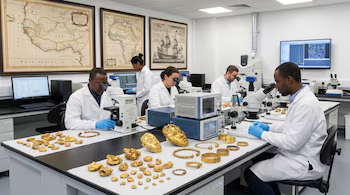
Scientific Analysis of Whydah Gally Gold
A recent analysis of West African gold recovered from the pirate shipwreck Whydah Gally in 1717 has effectively debunked the persistent colonial myth regarding alleged adulteration of metal by African traders. Researchers have employed advanced technology to assess the pieces from the shipwreck, demonstrating that the impurities found are a result of natural geological factors rather than deliberate fraud.
Revising Historical Misconceptions
This scientific investigation examined hundreds of gold artifacts traced back to an 18th-century pirate hoard, revealing a significant finding: the longstanding belief that African traders manipulated this precious metal lacks substantiated evidence. The impurities identified, predominantly silver with trace amounts of copper, align with the natural composition of deposits in the Gold Coast (modern-day Ghana), challenging the traditionally accepted European narrative of the African gold trade.
Historically, West African gold served as a crucial axis of international commerce. Before European Atlantic expansion, gold moved along trans-Saharan routes to the Mediterranean. Throughout the 17th and 18th centuries, nations like Portugal, the Netherlands, England, and France established a significant presence in the Gold Coast, yet doubts about the purity of the gold traded by the Akan peoples persisted.
Colonial Narratives and Cultural Bias
Notably, European chroniclers such as Pieter de Marees and William Bosman asserted that African traders adulterated gold with silver and copper to deceive foreign buyers. These accusations, perpetuated over generations, became embedded within Europe’s historical narrative. The analysis published by *Very Interesting* underscores that such testimonies were built on rumors and incomplete observations, lacking direct metal studies.

The shipwreck of the Whydah Gally, originally an English trading vessel, set sail for the Gold Coast in 1716. It was captured by the infamous pirate Samuel Bellamy, later known as “Black Sam.” After a storm sank the ship near Cape Cod in April 1717, the discovery of the wreck in 1984 unearthed over 300 pieces of intricate Akan gold—including beads, nuggets, jewelry, and other metallic artifacts.
Scientific Confirmation of Purity
To counter the previous allegations of adulteration, the research team carefully examined 70 artifacts from the wreckage and selected 27 for comprehensive testing. Utilizing advanced techniques like portable X-ray fluorescence (pXRF) and scanning electron microscopy with energy dispersive spectroscopy (SEM-EDS), the researchers determined each sample’s precise composition.
The results revealed that the gold’s purity ranged from 73.5% to 96.7%, with an average purity of approximately 87.5%. Notably, any detected impurities, primarily silver (up to 22%), were consistent with the geological characteristics of local deposits, while copper levels remained below 1%.
This evidence suggests that the chemical variations in African gold result from natural geology rather than intentional manipulation. Any slight increase detected in copper could be attributed to accidental contamination or minor additions to enhance the metal’s durability, not its value.

In summary, the findings from the Whydah Gally analysis fundamentally challenge the preconceived notions surrounding African gold. This research compels a reconsideration of the historical narrative regarding trade relations between Africa and Europe, emphasizing the sophisticated knowledge and practices of African traders.
Through advanced scientific investigation, the perceived anomalies in the gold’s composition highlight geological variations rather than fraudulent intent, thereby reaffirming the significance of African gold in historical commerce.