
The Ionosphere: A Shield and a Challenge
The Earth is enveloped by the ionosphere, a layer of ionized gas that serves as a dynamic boundary between our atmosphere and the vastness of outer space. This vital region protects us against solar radiation by absorbing ultraviolet rays and X-rays, while also functioning as a medium for conducting radio waves and satellite signals.
The Mystery of Nighttime Disruptions
However, the ionosphere poses challenges when night falls at the magnetic equator. A phenomenon appears that can destabilize GPS, air communications, and telecommunications. Despite ongoing studies in other equatorial regions, the African Atlantic sector has remained largely unexplored. This is where Tenerife plays a crucial role, as the German Aerospace Center (DLR) has been monitoring this area for over a decade.
Discovery of Plasma Bubbles
The DLR team recently confirmed the presence of equatorial plasma bubbles (EPB) over Tenerife at the XVII International Equatorial Aeronomy Symposium (ISEA-17). Though this phenomenon is not entirely new, it marks the first time it has been recorded systematically in this part of the Atlantic. The DLR utilized a GNSS receiver alongside an atmospheric luminescence detector to study these plasma bubbles on both small and large scales.
Characteristics of Plasma Bubbles
These bubbles form exclusively at night, with peak activity occurring during equinoxes. They can reach altitudes of up to 1,700 kilometers above the geomagnetic equator, with widths ranging from 40 to 100 kilometers and moving eastward at approximately 100 meters per second. The unpredictability of their appearance complicates any forecasting efforts, even in well-studied regions.
Significance of Plasma Bubbles
The consequences of plasma bubbles extend far beyond atmospheric curiosity. As they ascend, they generate ionospheric scintillation—rapid fluctuations in radio signals that degrade GPS accuracy, disrupt air communications, and impact satellite telecommunications. These issues are not merely theoretical; the European navigation system EGNOS felt such disruptions during the geomagnetic storm of April 2023.
Challenges for Aviation and Infrastructure
Moreover, the spatial gradient induced by EPBs poses challenges for aircraft guidance systems during precision approaches, highlighting the need for improved understanding of these phenomena. Investigating plasma bubbles in the African Atlantic region becomes crucial for ensuring aviation safety and maintaining the integrity of local digital infrastructure.
Context and Mechanisms
Research from the Complutense University of Madrid in collaboration with the ICTP of Trieste explains that plasma bubbles originate from decreases in electron density caused by Rayleigh-Taylor instability in the equatorial night sector. As the sun sets, the ionosphere’s stability declines, causing the lighter plasma to rise and create voids devoid of electrons—essentially forming the bubbles.
Similar Findings at the Pyramids of Giza
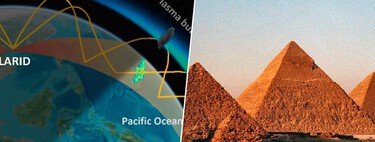
This phenomenon has also been detected near the pyramids of Giza, another area in North Africa. In November 2023, a radar station on China’s Hainan Island discovered an ionospheric disturbance over Giza, approximately 9,500 kilometers away. This detection, using a specialized radar technology, provides a unique comparison to the ongoing research in Tenerife.
Research Methods and Comparisons
The DLR’s approach involves using a GNSS receiver to capture the flickering caused by plasma bubbles in satellite signals, allowing them to identify irregularities without fully revealing the structure of the bubbles. To ascertain the actual shape and size, they rely on the atmospheric luminescence detector that measures the faint light emitted by ionospheric oxygen at night.
Exploring Further
While the DLR’s findings are preliminary and presented as a poster rather than a comprehensive scientific paper, there are many unanswered questions, including the frequency of occurrences over Tenerife and seasonal variations. Each finding adds another layer to our understanding of these fascinating plasma phenomena.