
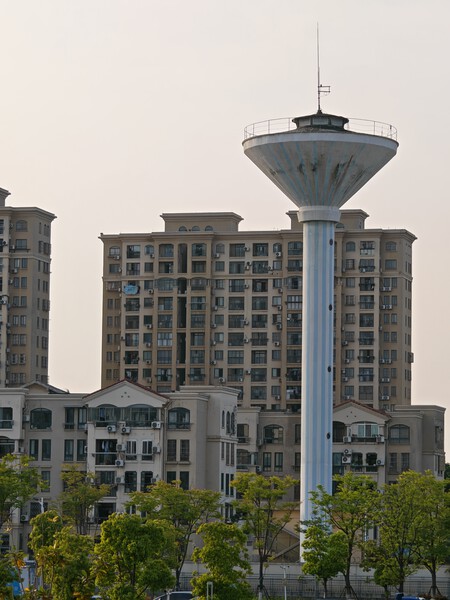
A Journey Beyond Borders: Beijing to Wuhu
A new day dawns in Beijing, and I’m filled with excitement as I prepare for a long train journey to Wuhu—the headquarters of the Chery group. This trip marks my inaugural experience on both a bullet train and a Chinese railway system.
Understanding Wuhu’s Size
Curiously, when I spoke to local Chery employees about Wuhu, they described it as a “small city.” With a population of four million, Wuhu is indeed larger than many cities worldwide, including Madrid, which has about 3.4 million residents. This perspective highlights how living in a country of 1.4 billion inhabitants can alter one’s perception of scale.
Wuhu is situated roughly 1,000 kilometers south of Beijing, nestled between Wuhan and Shanghai. To drive there, Google Maps estimates an arduous 11-hour journey. However, the train handles this in about four and a half hours, providing ample opportunity to delve deeper into the workings of the Chinese railway network.
The Extensive Chinese Railway Network
China has made remarkable strides in electrification and railway development, akin to its advancements in electric and hybrid vehicles. In comparison to Spain, which boasts 15,652 kilometers of roads—4,000 of which are high-speed—the Chinese high-speed rail network is by far the most extensive in the world.
A Numerical Perspective
According to the Chinese government, the country closed last year with a staggering 165,000 kilometers of track, including over 50,000 kilometers classified as high-speed. To put this in context, 4.59 billion passengers utilized Chinese railways in 2025, marking a 6.4% increase from the previous year. In contrast, Spain’s rail system moved just 177.6 million passengers during the same period.
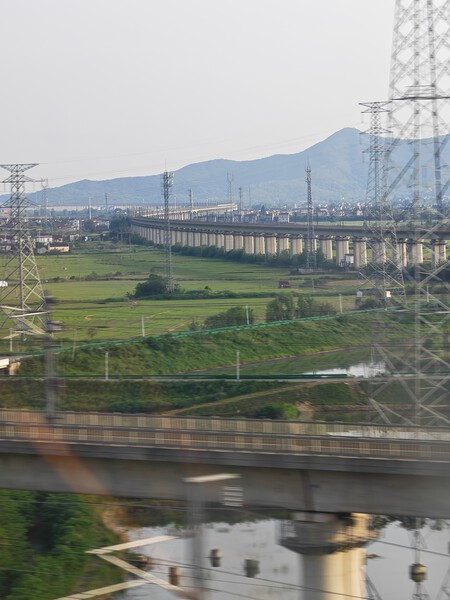
By 2025, China indicated plans to add 2,000 kilometers more of railway to its network. With a future goal of 274,000 kilometers by 2050, China is committing significant investments (like the $20.9 billion allocated in the first quarter of 2026) to ensure the rapid expansion of its rail systems.
The Experience of High-Speed Travel
The China State Railway Group Company, a state-owned enterprise, oversees the majority of railway operations. The network features several corridors concentrated in the eastern part of the country, where much of the population resides.
While the Chinese railway system is undeniably expansive, it’s also impressively fast. My journey from Beijing to Wuhu is accomplished at a steady 347 km/h. Interestingly, the train’s speed does not feel jarring. The ride is smooth and far less vibrational than trains I’ve previously experienced in Spain.
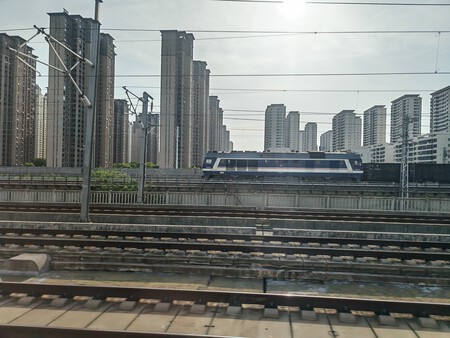
This incredible speed allows the train to make brief stops, further optimizing travel time. In a country of such vast dimensions, investing in railway systems not only facilitates passenger transport but is essential for efficient goods transport.
A Competitive Edge
China enjoys a competitive advantage with various links in its supply chain closely tied together. Surprisingly, railways transported 5.27 billion tons of freight in 2025, a 2% increase from the prior year. However, road and air transport still play significant roles in the logistics of domestic and international goods.
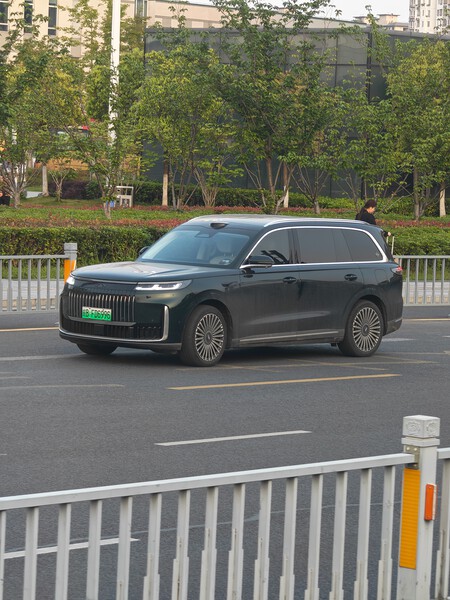
Tomorrow, my journey continues in Wuhu, exploring the heart of the Chinese motor industry. Stay tuned for more insights from this captivating city.
More Readings:
- Journey to the Center of the Chinese Motor (Part 1): A Walk Through Beijing, Ebro, Chery, and the Silent Streets
- Journey to the Center of the Chinese Motor (Part 2): I Have Seen the Future of Cars in Beijing, and Yes, It Is Electric (and Very Cool)