
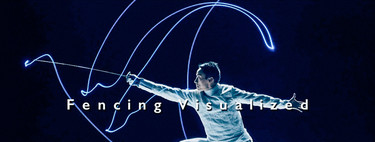
The tip of a foil in a professional fencing competition moves faster than the human eye can follow, and this limitation has confined the sport to a secondary role in broadcasts for decades. A Japanese studio, Rhizomatiks, has been developing an innovative solution since 2012 that combines 4K cameras, deep learning, and augmented reality. This groundbreaking technology is set to debut on April 25 during a professional competition in Los Angeles.
The Challenge of Visualizing Fencing
It’s difficult to follow. Fencing encompasses complex rules such as right of way in foil and saber, used to determine point winners when fencers touch simultaneously. This pushes spectators to closely track the weapon’s intricate movements in fractions of a second. According to the Rhizomatiks official technical documentation, the weapon’s tip occupies only a few pixels, even in 4K resolution. Furthermore, the blade’s flex during performance further complicates tracking through traditional processing methods.
How Fencing Visualized Works
Introducing Fencing Visualized. This visualization technology stems from a collaboration between Rhizomatiks, led by Daito Manabe—known for his work with artists like Björk and the closing ceremony of the Rio 2016 Olympics—the Dentsu Lab Tokyo agency, and Olympic fencer Yuki Ota. Inspired by previous projects involving motion capture in dance, the team’s goal is to create an engaging viewer experience. The project officially began in 2013 and featured in Tokyo’s bid for the 2020 Games.
Earlier versions relied on retro-reflective markers attached to the weapon, tested live during the Yuki Ota Cup in 2014. By 2017, reflective tape was favored to minimize disruption.
Advancements through Deep Learning
From markers to deep learning. A significant technological advancement occurred in 2016, allowing the system to operate during competitions without impacting athletes’ equipment. This shift involved rewriting motion detection algorithms using deep learning. Engineer Kye Shimizu describes the solution as a multistage network based on YOLO v3, utilizing data from 24 4K cameras positioned alongside the track. These cameras cross-reference results to accurately estimate the position of the foil’s tip.
This updated version made its exhibition debut at the 71st Japan National Championships in 2018 and was featured in official competitions the following year. The technology saw its crucial Olympic application during the Tokyo 2020 Games, laying the groundwork for future adoptions.
Commercial Aspirations
Money. The American premiere on April 25 aligns with the World Fencing League (WFL), a professional league founded by three-time Olympian Miles Chamley-Watson. The WFL invites twelve mixed teams, distributing $100,000 in prizes. Described as a blade tracking system using AI, its design aims to make the sport accessible to new viewers, ensuring that every round is easily comprehensible, regardless of prior knowledge about the regulations.
The Future of Fencing Broadcasting
More visions of the future. Fencing Visualized is part of a broader trend in sports broadcasting technology. Systems like Hawk-Eye in tennis and cricket, and Second Spectrum in the NBA and Premier League, echo this advancement. However, tracking the minute tip of a sword poses unique challenges compared to larger, more visible objects. Looking ahead, these innovations correspond with the International Olympic Committee’s initiatives, such as the shift towards an 8K experience facilitated by partnerships with companies like Alibaba Cloud and Intel. The forthcoming Los Angeles 2028 Games could provide a prime platform for integrating this technology into mainstream sports representation.
In sum, the intersection of advanced technology and traditional sports like fencing demonstrates that the endless quest for improvement can elevate even the oldest athletic competitions to new heights of relevance and engagement.