
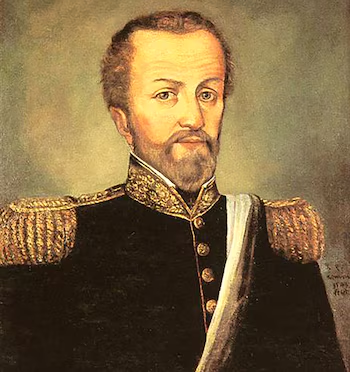
The Brave Charge of Juan Lavalle
In 1822, Sergeant Major Juan Lavalle, at the young age of 24, led a squadron of 96 horse grenadiers against overwhelming odds. This valiant regiment, known for its storied history, had been formed under the influence of José de San Martín. Lavalle, who had enlisted at just 15, was eager to prove himself on the battlefield.
Context of the Conflict
At this time, Spanish forces were retreating from South America, plagued by defeats across the continent as Simón Bolívar advanced through Colombia, Venezuela, and Ecuador, while San Martín solidified his hold over Peru. Antonio José de Sucre, the commander of the southern army, pursued the declining Spanish military, carefully strategizing each movement.
The Royalist Position
The royalists had established a defensive stance near Riobamba, a town with a tumultuous history, having been rebuilt after a catastrophic earthquake in 1797. The Spanish forces, comprising around 420 troops, were positioned comfortably, with cavalry leading the way.
Lavalle’s Experience
Lavalle was not new to warfare. Despite earlier setbacks, including his absence at the San Lorenzo battle, he gained valuable experience during his campaigns. He fought under notable leaders and faced both victories and humiliations, gaining insights that would serve him well.
Preparing for Battle
On April 21, 1822, as rain poured over the Tapi plain, Sucre assessed Lavalle’s regiment as his most seasoned cavalry, especially compared to the demoralized Colombian Dragoons. Lavalle, tasked with scouting enemy movements, spotted the Spanish forces entering a narrow defile.
The Audacious Charge
Recognizing the tactical opportunity, Lavalle acted decisively. He rallied his men, ordered them to draw their sabers, and, with a thunderous shout of “To slaughter!”, launched a relentless assault on the Spanish cavalry. The shock of the attack caused confusion among the enemy ranks, with several Spanish soldiers falling swiftly.
The Aftermath of the Encounter
Despite the odds heavily favoring the enemy, Lavalle’s courageous maneuver resulted in a significant victory. The enemy, realizing their peril, retreated chaotically, suffering considerable casualties. While Lavalle’s squadron sustained a few losses, including Timoteo Aguilera and Vicente Franco, the impact of their bravery was felt throughout the ranks.
Recognition and Legacy
The government of Peru later honored Lavalle and his grenadiers for their valor, issuing a decree on June 7 that awarded them a distinguishing light blue shield, symbolizing their heroic efforts. Lavalle’s legacy grew, earning him the moniker “the Lion of Riobamba.” Even in his darkest times, he wore that shield proudly, a reminder of his courageous commitment to his country.
Conclusion
Juan Lavalle’s audacious charge in Riobamba exemplifies the spirit of courage and determination that defined the struggle for independence in South America. His story is a testament to the impact one individual can have in the face of overwhelming adversity.