
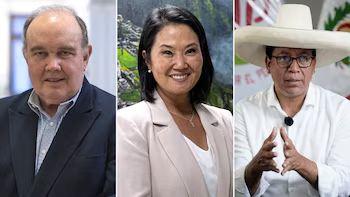
The April 12, 2026 general elections in Peru have led to intense speculation about who will accompany Keiko Fujimori in the upcoming second round. As of four days post-election, the National Office of Electoral Processes (ONPE) has only nearly completed the count, with leftist candidate Roberto Sanchez at 11.99% and far-right candidate Rafael Lopez Aliaga close behind at 11.93%, separated by fewer than 9,000 votes.
Current Electoral Landscape
Fujimori is ahead with 17% of the vote, positioned against a backdrop of 35 candidates—an unprecedented number for Peru. Election day itself was marred by chaos; reports of disorder emerged, prompting accusations of “insurgency” from candidates and calls for international observers to address fraud claims. Despite the ongoing count, complete scrutiny is not expected until the weekend, indicating that the selection of Fujimori’s rival may stretch into the following week.
A Decade of Political Turmoil
To grasp the implications of these elections, one must consider the turbulent political climate of the last decade. Peru has experienced eight presidents in ten years , enduring multiple impeachment attempts and a Congress dissolution. The political crisis escalated significantly in 2022 when President Pedro Castillo attempted to dissolve Congress.
The introduction of a bicameral system after three decades and multiple systemic reforms has left the nation grappling with logistical challenges voluminous enough to complicate the electoral process. This year’s elections were billed as the most complex in recent history, amplifying already present frustrations and distrust towards electoral authorities.
Key Players in the Election
Keiko Fujimori, the Fourth-time presidential candidate, is often overshadowed by her father’s controversial regime but maintains firm support from Lima and proponents of the economic policies of the 1990s.
Rafael Lopez Aliaga has garnered attention with his combative, ultra-conservative stance, primarily gaining traction in Lima. However, demographic shifts suggest that his local appeal might not translate nationally, placing him at risk of falling to third place.
Roberto Sanchez, the unexpected figure from “Together for Peru,” rallies support from rural voters and claims a connection with the jailed Pedro Castillo, presenting a clear challenge to establishment figures.
Logistical Challenges and Electoral Chaos
Over 27 million Peruvians were set to decide on their leadership on April 12. However, an unforeseen logistical collapse—exacerbated by delays in material distribution—led to polling sites opening several hours late, requiring some voters to return the next day.
The ONPE’s failure to adequately prepare resulted in public outcry, characterized by long lines and empty polling stations. This chaos enabled Lopez Aliaga to voice concerns about election integrity even before the results were finalized, fostering a climate of distrust.
Impending Scenarios for the Second Round
With the second round set for June 7, the focus remains on which candidate will challenge Fujimori. Two primary scenarios present themselves:
Scenario 1: Fujimori vs. Sanchez
A face-off between Fujimori and Sanchez could exacerbate divisions within Peru, echoing the rift seen in previous elections. Fujimori’s appeal to centrist voters fearing a return of the leftist policies of Castillo might be pivotal.
Scenario 2: Fujimori vs. Lopez Aliaga
Alternatively, a showdown between two right-wing candidates could present a unique political challenge. Both candidates have had their share of controversies, potentially leading to increased voter abstention or unexpected voting patterns from disillusioned citizens.
Regardless of who emerges as Fujimori’s opponent, the political landscape is unlikely to stabilize soon, as the new president will inherit a fragmented Congress and a populace deeply skeptical of government institutions.
Conclusion: A Broader Perspective
The situation in Peru reflects broader global issues of democratic erosion, as institutions maintain appearances while lacking legitimacy. Although adversity has been a constant, the upcoming elections represent a significant moment for the nation as it navigates the complexities of its electoral challenges.
As Peru prepares for the second round, it remains essential to watch how these dynamics will play out, as citizens continue to demand both accountability and stability in governance.