
Understanding the Myth of Flying Spiders
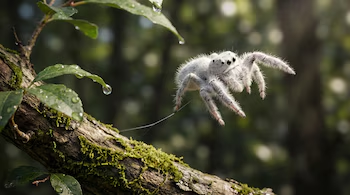
The image of “flying spiders” often captures public imagination, generating myths and confusions about these arachnids. However, unlike birds or insects, no spider possesses wings or can perform active flight.
As noted by HowStuffWorks, this fascination arises from a mix of popular myths and observable behaviors that initially seem to defy natural laws. These stories perpetuate the misconception of “flying spiders”.
What people perceive as “flight” is actually an air travel strategy developed to meet survival needs. These evolutionary responses do not equate to actual flight but instead reflect specific adaptations.
Spider Movement: The Selenops and Directed Fall Phenomenon
The genus Selenops, known as “flatties”, showcases an interesting adaptation called “directed fall”. When these spiders fall from great heights, they can guide their bodies towards nearby trunks, reducing predator encounters on the ground.
Experiments highlighted by HowStuffWorks reveal that dropping Selenops spiders from heights of up to 25 meters allows them to maneuver in the air due to their flat bodies and extended legs. This ability illustrates an evolutionary adaptation influenced by gravity and aerodynamics, not to be confused with autonomous flight.
The Ballooning Phenomenon in Spiders
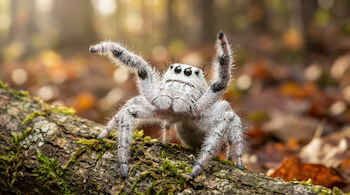
Ballooning, or “balloon flight”, is a well-known technique among arachnids. In this process, primarily young spiders release silk threads that are captured by the wind, enabling them to be transported over considerable distances. However, they lack control over their direction while airborne, with the wind acting as the main propulsion force.
This behavior plays a crucial role in species dispersal and facilitates colonization of new habitats. After storms or strong winds, it’s common to find spiders unexpectedly in yards and homes, exemplifying their reliance on natural forces for movement.
Impact of the Joro Spider in the United States
The joro spider (Trichonephila clavata), native to Asia, has gained attention in the southeastern United States due to its rapid spread. Utilizing ballooning as its primary means of transport, this species effectively colonizes new territories, raising ecological concerns.
So far, no significant harm to native species or humans has been reported. The joro spider’s presence illustrates how aerial dispersal strategies contribute to species expansion while simultaneously perpetuating the myth of spider flight.
Diversity and Adaptations in Spider Air Travel
Beyond directed falling and ballooning, spiders exhibit numerous adaptations for aerial movement and survival in high environments. Some species have evolved body shapes that enhance wind resistance or promote gliding, while others effectively utilize their silk for purposes like building bridges or escaping predators swiftly.
This variety of strategies demonstrates an evolutionary adaptability, allowing spiders to inhabit diverse ecosystems and react to shifting environmental pressures. While none of these mechanisms equate to true flight, they highlight the remarkable capacity of these arachnids to exploit environmental resources and endure challenging conditions.