
Rediscovering Nubia: The Remarkable Find in Dongola
If we think about characters and civilizations in African history, most of us imagine the pharaohs and pyramids of Ancient Egypt. However, just to the south lies a treasure trove of history in the Kingdom of Makuria, whose capital was Old Dongola. This significant city, situated on the banks of the Nile, flourished for nearly a thousand years as a hub of power, commerce, and culture.
The Historical Context of Old Dongola
While Europe languished in the Middle Ages, Dongola was a thriving Christian metropolis. It even resisted the advances of Arab armies that swept through North Africa. Over centuries, however, the city declined, Islamized, and became lost to time, buried beneath desert sands. The region of Nubia had become an echo of the past, with few written records and limited archaeological excavations until a recent pivotal discovery changed everything.
A Pivotal Discovery
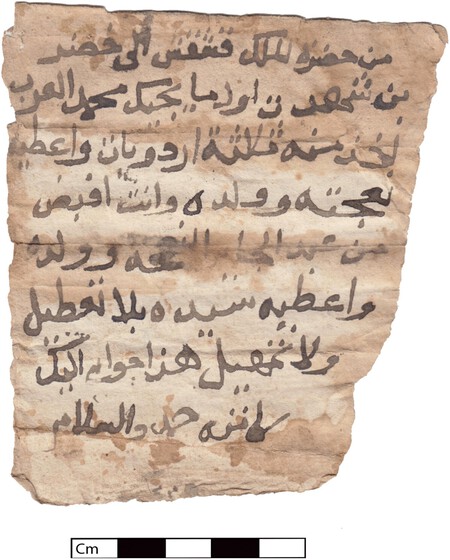
Recently, archaeologists uncovered a fragment of Arabic paper from a garbage dump in Old Dongola, specifically within a citadel known as the “King’s House.” This 10 × 9 centimeter document is an administrative decree issued by King Qashqash, commanding a subordinate named Khiḍr to facilitate an exchange involving sheep, cotton cloth, and a headdress. It was written by the scribe Hamad and suggests that a vibrant epistolary network existed around the royal court.
The first face of the King’s order. M. Rekłajtis/PCMA in Barański et al. 2026
Significance of the Discovery
This find is monumental for several reasons. Firstly, it confirms the historical existence of King Qashqash, who was previously known only through oral tradition and references in texts like the Kitāb al-Ṭabaqāt. The confirmation helps shed light on the so-called “Dark Ages” of Nubia, a period often misrepresented in historical narratives as one of constant warfare, largely based on accounts from the 16th century by travel writer Leo Africanus.
In reality, the newly discovered document indicates that King Qashqash was involved in managing goods and networks of trade rather than being entirely preoccupied with battle. This reflects a politically active Nubia engaged in complex administrative tasks, revealing an intricate social fabric.
Understanding Nubia’s Dark Ages
Old Dongola served as the capital of the medieval Christian kingdom of Makuria, one of the prominent kingdoms in the Nile Valley. By the mid-14th century, however, it lost much of its significance and eventually became embroiled in the socio-political upheavals that characterized what historians now refer to as the Sudanese “Dark Ages.”
During this period, Dongola stood at a geopolitical crossroads, facing pressure from Ottoman Egypt and the Funj Sultanate from the south. It is during this tumultuous era that Qashqash reigned, marking a significant historical period previously under-researched.
Research Methodology
The PCMA research team at the University of Warsaw employed multiple methods to date and contextualize the document. They utilized numismatic evidence, employing Ottoman silver coins from the same stratum. Radiocarbon analysis of organic matter from the garbage dump, along with literary cross-referencing from the Kitāb al-Ṭabaqāt, helped to reconstruct the timeline of King Qashqash’s reign effectively.
A Broader Implication
The significance of this document extends beyond confirming Qashqash’s rule. It provides insight into the socio-political dynamics of Nubia during a transformative time. Written in Arabic, the text displays grammatical inconsistencies that signal a transition towards Arabization in Nubia, indicating the gradual blending of cultures.
Interestingly, the archaeological evidence complements the local oral memory. The inhabitants of Dongola have referred to Building A.1 as the “King’s House” for generations, and descendants of Qashqash still reside nearby. This harmonious relationship between archaeologists and local communities has been crucial for accurate interpretations of findings.
Conclusion: A New Era of Understanding
The Qashqash document is just the first of approximately fifty Arabic manuscripts recovered from Old Dongola. These documents include various legal and administrative texts, revealing communication networks that connected religious and political elites, as well as nomadic leaders. A comprehensive analysis of these documents will illuminate the political, legal, and social history of pre-colonial Nubia, providing a more nuanced understanding of its rich and complicated heritage.