

The size of a company is, ultimately, a matter of perspective. For example, Inditex is worth more on the stock market than any other Spanish company, but Repsol far surpasses it if we look at its income. On the other hand, Mercadona, without being listed in any index, employs more people in Spain than any large multinational based in the country.
These three data points illustrate different business maps that barely overlap, yet together they form the business reality of Spain. They highlight how the Spanish economy is constructed, revealing which sectors generate wealth for investors, which contribute to significant income, and which companies truly drive employment in the country.
The Top 10 Companies of the IBEX35
When discussing large companies, one often refers to the IBEX35, the Spanish stock ranking. This index reflects investor confidence rather than a company’s revenue or its employee count.
Under this criterion, Inditex leads the list significantly. As of March 2026, its market value was approximately 163,500 million euros, peaking at 175,155 million by December 2025.
The investment bank Jefferies even raised its target price for the share, predicting a value exceeding 200,000 million euros. Inditex’s capitalization advantage is not due to its sales volume but stems from its profit margins—what the company founded by Amancio Ortega earns per euro sold.
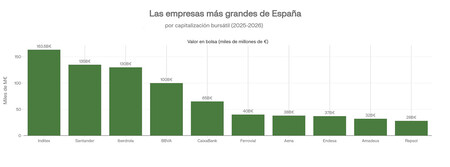
In the 2025 fiscal year, Inditex achieved a record net profit of 6,220 million euros, showing a 6% increase from the prior year. This explains why large banks like Santander, BBVA, or CaixaBank, and energy firms such as Iberdrola or Endesa, are lower on the stock market rankings.
In 2025, five Spanish companies exceeded 100,000 million euros in market value for the first time, though banks and energy companies still dominate the IBEX35. Notably, essential sectors like food, hospitality, and automotive have minimal representation in this index.
Largest Companies in Spain by Turnover
When evaluating companies based on their total revenue, the landscape shifts dramatically.
Oil, gas, and electricity companies typically top this list because they handle massive quantities of raw materials, despite retaining only a small portion as profit.
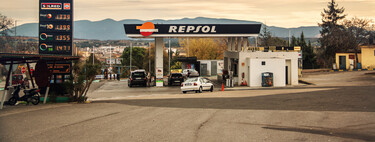
Repsol exemplifies this phenomenon. In 2025, despite a 14.5% drop in oil prices, its revenues reached 5,312 million euros, with a net profit of 1,899 million euros—a notable rise of 8.1%.
On the other hand, Mercadona stands out as a surprising leader in turnover. Not listed on any stock market, the Valencian grocery chain reported €41,858 million in sales (an 8% increase) and a net profit of €1,729 million (a 25% increase) in 2025, securing a 28.5% market share in Spain’s food sector.
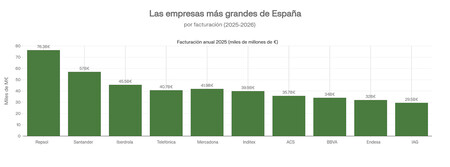
Juan Roig, Mercadona’s founder, labeled the fiscal year “historical.” Meanwhile, Inditex, despite being the most valuable in terms of market capitalization, ranks lower in revenue overall.
Largest Companies in Spain by Number of Employees
It’s often assumed that large companies require hefty workforces. However, this notion is increasingly challenged by ongoing layoffs in the tech sector.
The reality is different as the list of largest employers in Spain reveals. The top employer is not the largest by sales but rather Santander Bank, which employs over 198,400 people.
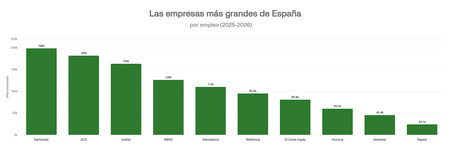
Mercadona follows with 110,000 employees across Spain and Portugal, having raised salaries by 8.5% in 2025. Conversely, Repsol, leading in revenue, employs only about 25,000 workers due to high automation levels.
The Largest Companies in Spain by Autonomous Community
Analyzing Spain’s business landscape by autonomous community reveals more about regional economies than broader national statistics.
Autonomous Community | Company | Sector | Billing Approx. 2025 |
|---|---|---|---|
Madrid | Repsol | Energy and Oil | €76.3 billion |
Basque Country | Iberdrola | Electrical Energy | €45.5 billion |
Valencian Community | Mercadona | Food Distribution | €41.9 billion |
Galicia | Inditex | Textile Retail | €39.9 billion |
Cantabria | Santander Bank | Banking | €135 billion |
Though none of these local leaders are listed on the IBEX35, they employ thousands, helping shape their regional economies.
The automotive industry thrives in various communities while the food and agri-food sectors dominate others. Furthermore, Airbus exemplifies a significant presence in Andalusia, representing a robust aeronautical ecosystem.
In both Ceuta and Melilla, local service companies lead but with lower revenue figures, underscoring the scale differences between metropolitan and broader regional economies.
In conclusion, the interplay of these variables illustrates the complex landscape of Spain’s economic powerhouses, showing that size, employment, and revenue don’t tell a singular story.