
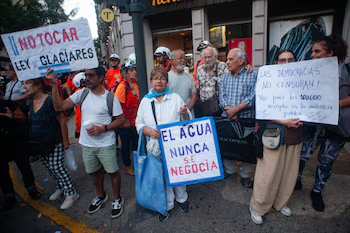
Controversial Debate Over Glacier Law Modification
The ruling party has secured endorsement from the commission to debate the modification of the Glacier Law, set for Tuesday at 3:00 p.m. This initiative arose from the national executive within the framework of projects outlined under the Large Investment Incentive Regime (RIGI).
Debating Sessions Ignite Opposition Concerns
In a recent plenary session, opposition parties expressed dissatisfaction during the presentation of two governors, mining ministers, and officials from the Mining Secretariat. Critics claim that the leadership from the Constitutional Affairs and Natural Resources committees skewed proceedings towards mining topics. Furthermore, it was pointed out that the project was not referred to the appropriate commission designated for such matters.
Support for the Initiative
Despite the backlash, Freedom Advances (LLA) has expressed confidence in gathering enough support. The coalition required 18 signatures in Constitutional Affairs (a committee of 35 members) and 16 signatures in Natural Resources (comprising 31 deputies). Reports confirmed that 19 and 18 signatures were achieved respectively during the debate.
Concerns About Environmental Impact
Caution from Lawmakers
Caren Tepp, a representative from Unión por la Patria, raised alarms regarding potential mining exploitation in glacier regions. She articulated concerns that if the proposal is approved, it could permit provinces to endorse mining activities within these sensitive areas.
Juan Grabois, a Kirchnerist deputy, went further, calling the proposed law “poisoned.” He insisted that mining activities in glacier zones would inevitably contaminate vital water sources.
Emotional Testimonials
Aldo Leiva, a deputy and former Malvinas combatant, shared emotionally charged narratives from his past, emphasizing the critical implications the Glacier Law carries for future generations.
Gabriela Estévez, a fellow deputy, condemned the project sharply, questioning, “What will be left for future generations? Absolutely nothing.” Her statement resonated with a deep concern for the environment and the responsibilities owed to the youth.
Political Reactions and Opposition
Bipartisan Discontent
Miguel Ángel Pichetto, recalling his prior vote for the original 2010 law, announced his opposition toward amendments, asserting that the existing legislation effectively balanced national and provincial interests while protecting environmental needs.
Sabrina Selva stated unequivocally that “it is a lie that they don’t go through the glaciers”, asserting that any modifications could facilitate the removal of critical glacier inventory, endangering water resources.
Legislative Warnings
Mónica Frade warned that lawmakers supporting this amendment would be responsible for any resultant environmental consequences. In a bold statement, she indicated, “No one will forget.”
Myriam Bregman characterized the amendment as “a true plundering project,” positing that it undermines the nation’s resources in favor of foreign mining corporations.
Conclusion: A Pivotal Moment for Environment and Economy
As the debate on the Glacier Law modification unfolds, it unfolds as a critical moment for Argentina. The tensions between economic incentives and environmental integrity will give rise to future discussions on the sustainability of natural resources in the face of legislative change. Tensions run high as lawmakers grapple with the implications of their decisions on the ecological treasures of the nation. The outcomes of these discussions will resonate not only today but also for generations to come.