
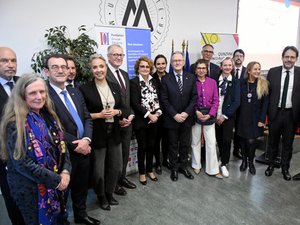
The Franco-German Fortnight: A Celebration of Cooperation
The eighth edition of the Franco-German Quinzaine d’Occitanie commenced on April 2 at the University of Montpellier’s Faculty of Law and Political Science. This year’s opening ceremony took a unique turn, featuring a round table discussion focused on the Weimar Triangle—a significant trilateral partnership established in 1991 among France, Germany, and Poland.
The Importance of the Weimar Triangle
With high-profile participants including Ambassador Stephan Steinlein of Germany, former minister Matthias Fekl, and Pierre-Frédéric Weber, the honorary consul of France in Szczecin, the event highlighted the importance of Franco-German ties bolstered by Poland’s involvement. Philippe Augé, president of the University of Montpellier, and Dean Guylain Clamour welcomed guests and set the stage for a rich dialogue concerning the challenges and prospects facing this trilateral cooperation.
The Weimar Triangle serves as a crucial framework for communication and collaboration between these three nations, fostering mutual understanding and support. Participants emphasized that its role has become increasingly vital in today’s geopolitical climate.
A Journey of Historical Context
Pierre-Frédéric Weber, as an international relations expert, provided a comprehensive historical overview of the Weimar Triangle. His insights elucidated the importance of understanding historical alliances to grasp current events in Europe. He noted, “The Weimar Triangle, so little known. Unfairly. Because it may lack visibility, but it works!” He underscored Poland’s dynamic growth, citing it as the “twentieth largest economy in the world,” showcasing its increasing influence on the European stage.
Connecting Through Emotion and Humor
The round table was marked by a blend of courtesy and candid exchanges, interspersed with moments of emotion and humor. These personal anecdotes and shared memories created a warm atmosphere, breaking the ice among speakers. The combination of serious discourse and light-hearted moments showcased the depth of connections among the participants.
Matthias Fekl provided a nuanced perspective, suggesting, “We underestimated Poland for a long time. But the Weimar Triangle cannot replace the Franco-German engine in Europe.” His statements reflected a growing acknowledgment of Poland’s evolving role in the European Union.
A Unified Front for Europe
In a time marked by conflict and uncertainty, Ambassador Stephan Steinlein emphasized the renewed necessity of the Weimar Triangle. He asserted, “The Weimar Triangle once again became indispensable with the return of war to the European continent. Our three countries speak with one voice: support for Ukraine is not an option, but a necessity.” This strong stance underscores the collaborative spirit that characterized the event.
As the round table concluded, the speakers reaffirmed their shared commitment to European integration and solidarity, reiterating their belief in a collective future, even amidst challenges. The relevance of the Weimar Triangle not only highlights historical ties but reinforces the ongoing commitment to a unified Europe—one that continues to evolve through dialogue, cooperation, and mutual respect.
This year’s opening of the Franco-German Quinzaine d’Occitanie served as a reminder of the enduring bonds among France, Germany, and Poland, fostering hope for a collaborative and progressive European landscape.