Understanding Buffett’s Investing Mastery
There are numbers that don’t need much explanation. Just take a quick look at them to understand why Warren Buffett has been considered the best investor in history for decades. The difference between the cumulative performance generated by Buffett’s investments through Berkshire Hathaway and the returns from the S&P 500 index is an abyss.
In its traditional letter to shareholders, Berkshire Hathaway summarizes its returns since 1965, providing a clear picture of the profound disparities in investment performance over time.
Stunning Visual Evidence
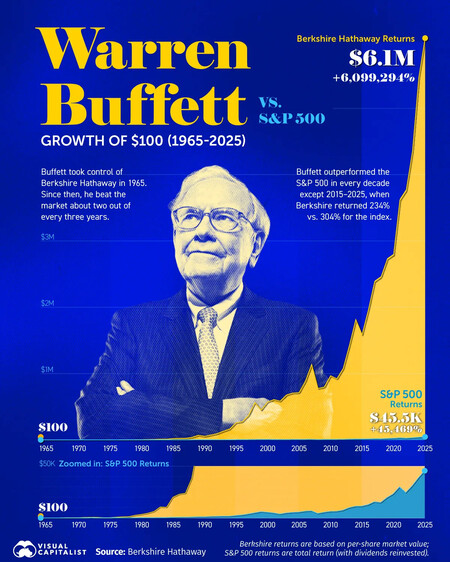
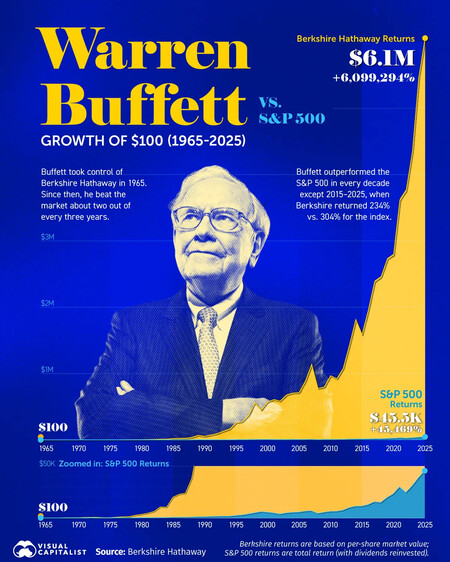
A great way to appreciate this difference is through a graph prepared by Visual Capitalist. This visual representation vividly shows how dramatically Buffett’s returns outpace those from the S&P 500, emphasizing that the gap is so significant that the S&P had to be zoomed in on to make its evolution visible.
Six Decades of Financial Returns
The annual report of Berkshire Hathaway for 2025 reveals an astonishing accumulated return of 6,099,294% for Berkshire, in stark contrast to the 46,061% for the S&P 500. If you had invested $100 in Berkshire Hathaway in 1965, that would be worth over $6 million today. In comparison, the same amount invested in the S&P 500 would have grown to just over $46,000.
The compound annual growth rate for Berkshire amounts to 19.7%, almost double the S&P’s 10.5%. This substantial difference highlights the power of compound interest, something Buffett grasped better than anyone else.
Good Years and Bad Years (Which Are Not So Bad)
Despite the impressive historical data, not every year saw Berkshire outperforming the S&P 500. In 2025, for example, Berkshire’s value rose by 10.9%, while the S&P soared by 17.9%. Historical instances include 1967 and 1999, where Buffett’s firm lost ground. However, where Buffett’s strategy particularly excels is in times of adversity. The S&P 500 experienced declines 13 times between 1965 and 2025, but Berkshire outperformed it in 11 of those years.
The Secret of Compound Interest
Buffett’s success doesn’t hinge on individual years but rather on consistent performance over time. When investments grow at a compound annual rate of 19.7% for six decades, the effects are exponential. Each year’s profits build on the previous capital, generating even more profits. It’s a difference between adding and multiplying, a principle that sits at the heart of Buffett’s investment philosophy.
Berkshire’s new CEO, Gregory Abel, likened Buffett’s strategy to the legendary baseball player Ted Williams, who focused on a limited area for hitting to achieve impressive averages. Abel articulated: “A similar discipline, patience, and judgment define Warren’s approach to investing.”
The Oracle’s Investing Nose
In the 2025 letter, Abel articulated the investment philosophy underpinning Berkshire’s strategy, which is built on understanding businesses with durable competitive advantages. Buffett’s long-standing investments in companies like Apple, American Express, and Coca-Cola exemplify this strategy. By concentrating on businesses that he comprehends well and respecting their leadership, Buffett has generated returns that significantly outstrip the original purchase prices.
The Oracle of Omaha didn’t attempt to predict the future; he focused on making informed choices, exercising patience, and allowing time to work in his favor—an approach that has proven remarkably effective.