
The Controversy Over the “Cazzu Law”
Background on the “Cazzu Law”
The “Cazzu Law” has stirred significant public interest and legal discourse in Mexico. Named after Argentine singer Cazzu, the proposed legislation aims to improve administrative procedures regarding child custody and welfare, particularly in cases of parental abandonment. The initiative, spearheaded by Sandra Arreola Ruiz, a representative from the Green Ecologist Party of Mexico (PVEM), seeks to streamline processes for obtaining mobility permits and ensure child welfare.
Alex Rodríguez’s Defense of Christian Nodal
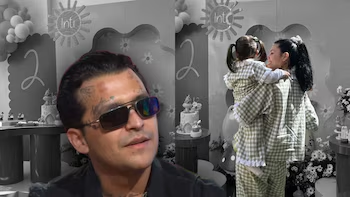
Alex Rodríguez, a prominent journalist, recently ignited a firestorm of criticism after defending Mexican singer Christian Nodal during a YouTube interview with Arreola Ruiz. Rodríguez cast doubt on Cazzu’s credibility concerning claims around custody and financial support for her daughter with Nodal. He argued that the current naming of the law could mislead the public and unfairly demonize Nodal without a proper judicial ruling.
Rodríguez stated, “We are using Cazzu’s name to put a law and I want to give you information that I don’t know if you know or not. There is a person named Cazzu who, when he came to Mexico, has contradicted himself on several occasions.” His focus was on the validity of the claims made and the impact they may have on Nodal’s reputation.
Legal Implications and Public Reaction
The debate intensified as Rodríguez questioned the appropriateness of using Cazzu’s name in the law, stressing that the allegations against Nodal have yet to be substantiated in court. He emphasized that “What has been leaked on social networks is a lie to generate hatred,” and warned that associating such a name with a legislative proposal could be damaging.
Public response to Rodríguez’s defense has been overwhelmingly critical. Users on social media platforms flooded his accounts with comments accusing him of bias and spreading misinformation. Many expressed their disdain for how he sided with Nodal while openly questioning Cazzu’s statements. Comments like “Defend the indefensible” and “You look like a fan” encapsulated the discontent from social media users.
The Need for Legislative Clarity
In the end, the controversy surrounding the “Cazzu Law” highlights crucial societal issues—primarily how legal frameworks interact with personal narratives in the public domain. Representative Arreola Ruiz reiterated her intent to focus on the legislation’s practical implications rather than its name, stating, “The cause is more important than the issue of the name”. She also expressed openness to modifying the law’s title in light of the unfolding debate.
Conclusion: A Call for Understanding
The ongoing discourse surrounding the “Cazzu Law” underscores complex interactions between celebrity culture, legal accountability, and societal welfare. As debates continue, it is evident that names carry weight and can influence public perception and legal processes. For now, the future of the “Cazzu Law” remains intertwined with public sentiment and the evolving narratives of its key players, pushing for a more just solution for children affected by parental disputes in Mexico.