
China’s Surge in Arms Production
Although the ongoing conflict between the United States, Israel, and Iran captures global headlines, the broader narrative in international relations reveals a stark reality: the entire world is undergoing a significant rearmament phase. Europe is realizing its military inadequacies, while China is positioning itself as increasingly self-sufficient. The country is transitioning from a reliance on imports to a robust domestic production capability.
Shifting Dynamics in Global Arms Trade
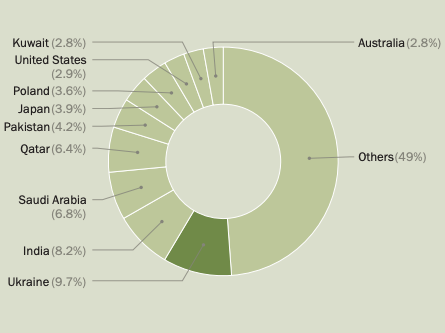
The recent report titled “Trends in International Arms Transfers, 2025” by the Stockholm International Peace Research Institute highlights critical trends in global heavy weapon trades from 2016 to 2025. Notably, it indicates that China is not just participating in the global arms market; it is asserting itself as a dominant player.
China’s Transformation
Over the past decade, China has shifted from being the fifth-largest arms importer to barely making the list of the top 20. While global arms transfers increased by 9.2% from 2021 to 2025, China’s role as an arms trader has evolved considerably. It is now the fifth-largest arms exporter, with a market share of 5.6%, effectively selling more while buying less.
This transformation underscores a fundamental change: China no longer needs to import weapons that it can manufacture domestically. Remarkably, China has surpassed the U.S. in nuclear submarine production, making it clear that its defense industry has achieved significant autonomy.
The Importance of China’s Independence
China’s self-sufficiency in arms production signifies its development into the world’s second-highest military spender, according to the International Institute for Strategic Studies. This removes a potential vulnerability: the pressure points created by dependency on foreign arms supply chains. Moreover, China’s tightening grip on rare earths—essential materials for advanced weaponry—further cements its strategic autonomy.
Geopolitical Implications
China’s rising influence extends beyond its borders. It plays a crucial role in international defense dynamics, particularly within its own region. While it remains a significant supplier for Pakistan, it also dominates the Sub-Saharan African arms market and is starting to find footholds in European nations like Serbia.
Global Rearmament Context
The SIPRI report also contextualizes China’s arms transition within a global landscape marked by intensive rearmament, particularly in Europe, where arms imports surged by 210%. U.S. policy in the Asia-Pacific is increasingly focused on countering China’s influence, reinforcing allies like Japan, Australia, and South Korea.
From Russian Dependency to Autonomy
Historically reliant on Russian military technology, China’s imports have plummeted by 72% from 2016 to 2025. Although Russia still accounts for 66% of China’s total arms imports, this trend marks a pivotal shift in military strategy. Events such as the Taiwan Strait crisis in 1996 highlighted the need for China to develop its own defense industry.
China’s Growing Military Capability
Today, China boasts the world’s largest navy by ship count and leads in hypersonic missile deployment. The Pentagon anticipates that China will possess over 1,000 nuclear warheads by 2030. Its most recent military budget reflects a 7.2% increase, prioritizing technological self-sufficiency and defense innovation.
Implications for Global Stability
China’s reduced dependency on Russia signifies a loss for Moscow, as decreasing Chinese purchases drive Russian arms exports to historical lows. For the United States, China represents a daunting challenge—referred to as the “pacing threat.” This competition compels the U.S. to adapt rapidly, aiming to keep pace with China’s formidable industrial and technological advancements.
Moreover, neighboring countries are accelerating their defense procurements, spurred by fears of Chinese dominance and U.S. reinforcement initiatives. However, the question remains: how long can these nations maintain their defense postures in the face of China’s unmatched speed and capability in arms production?